

Oman Tax Authority Decision No. 180/2026: New Rules on Deductible Business Expenses Explained

The Oman Tax Authority has issued Decision No. 180/2026, introducing an important amendment to the Executive Regulation of the Income Tax Law. The Decision inserts a new Article 18 bis into the Executive Regulation, establishing specific conditions under which certain business expenses may qualify as deductible for income tax purposes. The amendments apply from the tax year commencing 1 January 2027. While the amendment is concise, its practical implications are significant for businesses operating in Oman, particularly those incurring costs as a result of directives or decisions issued by government authorities and public entities.
What Has Changed?
Decision No. 180/2026 introduces Article 18 bis to the Executive Regulation of the Income Tax Law. The new provision governs the deductibility of expenses incurred by taxpayers in complying with decisions issued by state administrative units and other public legal entities.
To qualify as a deductible expense, all of the following conditions must be satisfied.
1. The Expense Must Be Necessary for Carrying on the Business
The expenditure must be directly connected to the taxpayer's business activities and genuinely required for the operation of the business.
This requirement reinforces the principle that only legitimate business expenses—rather than optional or unrelated expenditures—should reduce taxable income.
2. The Deduction Must Be Approved by the Chairman of the Tax Authority
The Decision requires that the deduction be expressly authorised by the Chairman of the Tax Authority.
This introduces an additional regulatory safeguard and indicates that expenses falling within the scope of Article 18 bis are not automatically deductible merely because they were incurred.
Businesses should therefore maintain adequate documentation demonstrating the necessity and circumstances of the expenditure when seeking recognition of the deduction.
3. The Expense Must Not Arise from a Breach of Any Legal or Contractual Obligation
The Decision makes it clear that expenses resulting from a failure to comply with any obligation—regardless of whether the obligation arises under law, regulation, contract, or another legal source—will not qualify for deduction.
This provision reinforces the long-standing tax principle that taxpayers should not receive a tax benefit for costs arising from non-compliance or misconduct.
Repeal of Inconsistent Provisions
Decision No. 180/2026 also provides that any provisions inconsistent with the new amendment are repealed to the extent of the inconsistency, ensuring that Article 18 bis prevails over conflicting regulatory provisions.
Effective Date
The Decision was published in the Official Gazette and takes effect from the tax year beginning on 1 January 2027. Businesses should therefore assess their internal tax policies and accounting procedures in advance of the effective date.
Practical Implications for Businesses
The amendment serves as a reminder that taxpayers should:
- Maintain comprehensive records supporting the commercial necessity of expenses.
- Distinguish between compliance-related expenditures and costs arising from breaches of obligations.
- Evaluate whether expenses requiring recognition under Article 18 bis may necessitate approval from the Tax Authority.
- Review existing tax compliance procedures ahead of the 2027 tax year.
Conclusion
Although Decision No. 180/2026 introduces only a single new provision, it strengthens the regulatory framework governing deductible expenses and provides greater clarity on the treatment of costs incurred in complying with governmental directives.
Businesses should proactively review their tax governance frameworks to ensure that qualifying expenditures are appropriately documented and supported before claiming deductions under the amended Executive Regulation.
Oman's New Executive Regulation of the Securities Law (Decision E/11/2026): A New Era for Capital Markets Regulation

Introduction
The Sultanate of Oman has taken another significant step towards modernising its financial markets with the issuance of Decision No. E/11/2026, promulgating the Executive Regulation of the Securities Law issued under Royal Decree No. 46/2022.
The Regulation provides a detailed framework for implementing the Securities Law. It introduces comprehensive rules governing capital market institutions, securities offerings, investment funds, credit rating agencies, market conduct, investor protection, and regulatory enforcement. It reflects the Financial Services Authority's continued efforts to align Oman's capital markets with international best practices while supporting the objectives of Oman Vision 2040.
More than simply introducing new compliance requirements, the Regulation reshapes the legal and operational framework of Oman's securities market by promoting transparency, strengthening governance, enhancing investor confidence, and creating a more attractive environment for domestic and international investment.
Why This Regulation Matters
While Royal Decree No. 46/2022 established the legal foundation for Oman's modern securities market, its practical implementation depended upon detailed executive regulations. Decision E/11/2026 fills that gap by prescribing the operational rules applicable to market participants.
The Regulation seeks to create a well-regulated, transparent, and competitive capital market by introducing clearer licensing requirements, enhanced disclosure standards, stronger governance obligations, and more effective regulatory oversight. It also supports the introduction of new financial products and services while ensuring that investors benefit from higher levels of protection.
Overview of the Regulation
The Executive Regulation is divided into seven principal chapters, each addressing a key component of Oman's securities market.
1. General Provisions
The Regulation begins by establishing the general legal framework applicable to all participants in the securities market. It sets out key definitions, clarifies the scope of the Regulation, and outlines the fundamental obligations expected of regulated entities.
By providing consistent interpretative guidance, these provisions help reduce regulatory uncertainty and ensure that market participants operate within a clear and predictable legal framework.
2. Capital Market Institutions
One of the Regulation's most significant chapters concerns the licensing and regulation of capital market institutions, including brokerage firms, investment advisers, asset managers, and other regulated financial service providers.
The Regulation prescribes licensing procedures, minimum capital requirements, corporate governance standards, internal control mechanisms, risk management systems, compliance functions, and professional competency requirements for senior management and key personnel.
These measures are intended to strengthen institutional resilience, improve operational standards, and enhance public confidence in licensed financial institutions.
3. Operating Entities
The Regulation establishes detailed requirements for entities responsible for operating and managing the infrastructure of the securities market.
These provisions govern the licensing, responsibilities, operational standards, and ongoing regulatory obligations of market operators, ensuring that trading platforms and market infrastructure function efficiently, fairly, and transparently. The framework also enhances regulatory oversight by requiring operators to maintain appropriate governance, risk management, and reporting systems.
4. Credit Rating Agencies
Recognising the growing importance of independent credit assessments, the Regulation introduces a dedicated legal framework governing credit rating agencies.
The new rules establish licensing requirements together with obligations relating to independence, transparency, governance, record keeping, conflict-of-interest management, and internal controls. These measures are designed to improve the credibility and reliability of credit ratings, thereby enabling investors to make better-informed investment decisions.
5. Collective Investment Schemes
The Regulation significantly enhances the regulatory framework governing investment funds and other collective investment schemes.
It provides detailed rules relating to the establishment, licensing, management, administration, custody, valuation, disclosure, and ongoing supervision of investment funds. Fund managers are also subject to enhanced governance and compliance obligations aimed at safeguarding investors' interests and promoting sound fund management practices.
The revised framework is expected to encourage greater institutional investment while expanding the range of investment products available in Oman.
6. Issuers and Market Integrity
This chapter introduces extensive obligations designed to promote transparency and preserve confidence in the securities market.
Issuers are required to comply with enhanced disclosure requirements, including continuous reporting of material developments that may affect investors' decisions. The Regulation also contains provisions addressing insider trading, market manipulation, misleading disclosures, and other forms of market abuse.
Collectively, these measures reinforce the principles of fairness, equal treatment of investors, and integrity within Oman's capital markets.
7. Grievance Committee
To ensure procedural fairness, the Regulation establishes a formal mechanism for reviewing decisions issued by the Financial Services Authority.
The chapter sets out the procedures for filing grievances, conducting hearings, and issuing decisions. This structured review process strengthens regulatory accountability while providing market participants with an effective avenue to challenge regulatory decisions where appropriate.
Investment Banking Recognised as a Regulated Activity
One of the Regulation's most notable reforms is the formal recognition of investment banking as a regulated securities activity.
Licensed investment banks may undertake a broad range of services, including advising on securities issuances, underwriting public offerings, managing investment portfolios, providing investment research, structuring financial products, and offering corporate finance advisory services.
By expressly regulating investment banking, Oman moves closer to internationally recognised capital market frameworks and creates opportunities for more sophisticated financial services within the Sultanate.
Structural Separation of Banks' Securities Activities
The Regulation also introduces an important structural reform for licensed banks currently carrying out securities-related business.
Banks have been granted a three-year transitional period to transfer regulated securities activities into a separate legal entity. This segregation is intended to minimise conflicts of interest, improve governance, and enable more focused regulatory supervision.
Certain activities—including custody services, trustee functions, and underwriting—may continue to be undertaken by banks where permitted under the Regulation.
Transitional Compliance Requirements
To facilitate implementation, the Regulation grants existing capital market institutions a six-month period to regularise their operations and ensure compliance with the new requirements.
Until supplementary rules and guidance are issued by the Financial Services Authority, existing circulars and regulatory instructions will continue to apply insofar as they do not conflict with the Securities Law or the Executive Regulation. This transitional approach allows firms sufficient time to review their governance structures, internal policies, licensing arrangements, and compliance frameworks.
What Does This Mean for Businesses?
The new Executive Regulation will require many market participants to reassess their internal governance and regulatory compliance frameworks.
Listed companies should review their disclosure policies and reporting procedures to ensure continued compliance. Licensed financial institutions may need to strengthen governance arrangements, risk management systems, and internal controls. Banks engaged in securities activities should begin planning for the required structural separation, while investment managers and fund operators should evaluate whether their existing operational models satisfy the enhanced regulatory standards.
For investors, these reforms should result in greater market transparency, stronger regulatory oversight, and improved confidence in Oman's capital markets.
Conclusion
Decision No. E/11/2026 represents one of the most significant milestones in the evolution of Oman's capital markets since the enactment of the Securities Law in 2022. By introducing a modern and comprehensive regulatory framework, the Financial Services Authority has strengthened the legal foundations of the securities sector while fostering greater investor confidence, market integrity, and institutional accountability.
Although the Regulation introduces new compliance obligations for regulated entities, it also presents significant opportunities. By encouraging innovation, improving governance, and aligning Oman with international regulatory standards, the new framework is expected to enhance the attractiveness of the Sultanate as a regional investment destination and support the broader economic diversification goals of Oman Vision 2040.
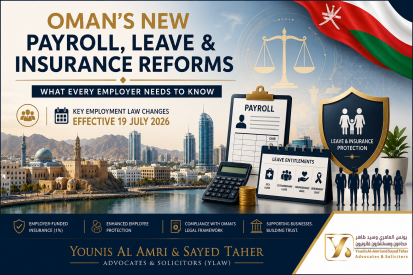
Oman's New Payroll, Leave & Insurance Reforms: What Every Employer Needs to Know
A New Era of Employment Protection in Oman
The Sultanate of Oman has taken another significant step towards modernizing its employment and social security framework by implementing the Sick Leave and Extraordinary Leave Insurance Branch under the Social Protection Law, effective 19 July 2026.
These reforms are part of the Government's broader strategy to establish a comprehensive and sustainable social protection system that aligns with Oman Vision 2040, while enhancing employee welfare and promoting a resilient labour market.
For employers, however, these changes extend beyond employee benefits. They introduce new payroll obligations, compliance requirements, and administrative responsibilities that demand immediate attention.
This article examines the legal framework, the practical implications for businesses, and the key actions employers should take to remain compliant.
The Legislative Framework
The reforms are principally governed by:
- Royal Decree No. 52/2023 promulgating the Social Protection Law;
- Royal Decree No. 60/2025, postponing the implementation of the Sick Leave and Extraordinary Leave Insurance Branch until 19 July 2026;
- Royal Decree No. 53/2023 promulgating the Labour Law;
- Decisions and implementing regulations issued by the Social Protection Fund (SPF).
Together, these legislative instruments form part of Oman's transition from the traditional pension model to an integrated social protection framework covering pensions, insurance, leave benefits and income protection.
What Has Changed?
The latest reforms introduce a dedicated insurance branch covering:
- Sick Leave Benefits
- Extraordinary Leave Benefits
Unlike previous arrangements in which employers bore the full financial burden of extended employee absences, the new insurance mechanism introduces a structured reimbursement model administered by the Social Protection Fund.
Employer Contributions
One of the most important changes concerns employer payroll obligations.
From 19 July 2026, employers are required to contribute:
1% of the employee's contribution wage towards the Sick Leave and Extraordinary Leave Insurance Branch.
Key Points
✔ Fully funded by the employer
✔ No additional employee contribution
✔ Mandatory payroll deduction reporting
✔ Contributions payable through the Social Protection Fund system
Employers should immediately review payroll software and contribution calculations to ensure compliance.
New Sick Leave Insurance
The insurance scheme provides wage replacement during prolonged illness, reducing the financial burden previously carried entirely by employers.
The benefit structure is as follows:
|
Period |
Benefit |
|
First 7 days |
Employer responsibility |
|
Days 8–21 |
100% of wage |
|
Days 22–35 |
75% of wage |
|
Days 36–70 |
50% of wage |
|
Days 71–182 |
35% of wage |
The maximum annual entitlement is 182 days.
Employers should note that medical certification and compliance with the procedures prescribed by the Social Protection Fund remain essential.
Extraordinary Leave Insurance
The reforms also extend financial protection to several categories of extraordinary leave, including eligible circumstances such as:
- Marriage Leave
- Bereavement Leave
- Compassionate Leave
- Leave accompanying a family member for medical treatment
- Widow's Mourning Leave
The specific eligibility requirements and reimbursement mechanisms are governed by the implementing regulations issued by the Social Protection Fund.
Expansion of Coverage
Another significant development is the extension of compulsory insurance coverage to specified categories of expatriate employees working in Oman.
This reflects the Government's objective of creating a more comprehensive and inclusive social protection system across both the public and private sectors.
Employers with multinational workforces should carefully review whether their expatriate employees fall within the scope of the new requirements.
Payroll Compliance: More Than a System Update
The reforms require more than simply adjusting payroll percentages.
Employers should undertake a comprehensive compliance review covering:
Payroll Systems
- Update payroll software
- Apply new employer contribution rates
- Ensure accurate reporting to the Social Protection Fund
Employment Contracts
Review employment agreements to ensure consistency with the new legislative framework.
Employee Handbooks
Leave policies should be revised to reflect the new insurance arrangements, reimbursement procedures and employee entitlements.
HR Procedures
Internal HR teams should receive training regarding:
- medical certification;
- reimbursement claims;
- reporting obligations;
- documentation requirements.
Why These Reforms Matter
The reforms demonstrate Oman's continuing commitment to:
- strengthening employee welfare;
- improving workforce stability;
- encouraging private sector employment;
- aligning employment legislation with international best practices;
- supporting sustainable economic development under Oman Vision 2040.
For employers, compliance is no longer simply a statutory obligation—it is an important element of corporate governance and risk management.
Recommended Actions for Employers
Businesses should consider taking the following steps without delay:
✓ Review payroll contribution calculations.
✓ Audit HR and payroll systems.
✓ Update leave policies.
✓ Review employment contracts.
✓ Train HR and finance teams.
✓ Ensure timely registration and reporting with the Social Protection Fund.
✓ Seek legal advice where existing employment arrangements require amendment.
How YLAW Can Assist
At Younis Al Amri & Sayed Taher Advocates & Solicitors (YLAW), we regularly advise multinational corporations, financial institutions, government entities and private businesses on employment law compliance and workforce restructuring.
Our Employment & Labor Practice provides comprehensive support, including:
- Employment law compliance audits
- Payroll and Social Protection compliance reviews
- Drafting and updating employment contracts
- HR policy reviews
- Regulatory advisory
- Employment dispute resolution
Whether you are reviewing your payroll framework or assessing the impact of the latest legislative reforms, our team is well positioned to help your organisation navigate these changes with confidence.
Conclusion
The implementation of the Sick Leave and Extraordinary Leave Insurance Branch marks another milestone in the evolution of Oman's employment law landscape. While the reforms strengthen social protection for employees, they also introduce new compliance obligations that require careful planning and timely implementation by employers.
Organisations that proactively review their payroll systems, employment documentation and HR policies will be better placed to ensure compliance, minimise operational risk and adapt to the evolving regulatory environment.
Disclaimer: This publication is intended for general informational purposes only and does not constitute legal advice. Specific legal advice should be obtained based on the facts and circumstances of each case
Royal Decree No. 66/2026: Strengthening Integrity in Oman Through the Criminalisation of Private Sector Bribery

Royal Decree No. 66/2026: Strengthening Integrity in Oman Through the Criminalisation of Private Sector Bribery
The Sultanate of Oman continues to strengthen its legislative framework through Royal Decree No. 66/2026, published on 23 June 2026, introducing significant amendments to the Penal Law (Royal Decree No. 7/2018) while simultaneously repealing Article 146 of the Labour Law (Royal Decree No. 53/2023)
These reforms represent more than a legislative update. They signal Oman's continued commitment to promoting transparency, accountability, ethical business conduct, and alignment with internationally recognized anti-corruption standards.
A Landmark Development in Oman's Criminal Law
Perhaps the most notable aspect of Royal Decree 66/2026 is the introduction of a new chapter dedicated exclusively to bribery in the private sector.
Historically, anti-corruption legislation has focused predominantly on public officials. The new provisions recognize that corruption within private businesses can equally undermine investor confidence, distort competition, damage corporate governance, and negatively impact economic growth.
The amendments therefore extend criminal liability to bribery occurring entirely within private commercial relationships.
The new provisions apply to:
* Private companies operating in Oman;
* Private establishments;
* Public international institutions headquartered in Oman.
However, they do not apply to individuals who fall within the statutory definition of a public official under Article 10(d) of the Penal Law, as those people remain subject to the existing public-sector bribery provisions.
Key Criminal Offences Introduced
1. Acceptance or Solicitation of Benefits
An employer, board member or employee commits an offence where they request, receive or accept any benefit or promise of a benefit in exchange for performing—or refraining from performing—an act connected with their duties.
Penalty
- Imprisonment from 1 to 3 years
- A fine of at least the value of the benefit received or promised
Importantly, liability may arise even where the requested act ultimately falls outside the offender's actual authority.
2. Abuse of Position
Where the benefit is received in exchange for violating employment duties or failing to fulfil a mandatory obligation, the offence becomes significantly more serious.
Penalty
- Imprisonment from 3 to 5 years
- A fine of at least the value of the benefit received or promised
This reflects the legislature's intention to impose stricter sanctions where corruption directly compromises organizational integrity.
3. Offering a Bribe
The legislation also criminalizes offering a bribe—even when the offer is rejected.
Penalty
- Imprisonment from 3 months to 1 year
This demonstrates that criminal liability is not dependent upon the completion of the corrupt transaction.
4. Liability of Bribe Givers and Intermediaries
The Royal Decree places equal emphasis on those who facilitate corruption.
Accordingly:
- The individual offering the bribe; and
- Any intermediary involved;
May be punished with the same penalties applicable to the recipient. However, the law introduces an important compliance incentive. Individuals who voluntarily report the offence before its discovery may benefit from an exemption from criminal punishment. Where disclosure occurs after authorities have discovered the offence, the confession may still be treated as a mitigating factor during sentencing.
Repeal of Article 146 of the Labor Law
Royal Decree No. 66/2026 also repeals Article 146 of the Labor Law in its entirety. Although this amendment may initially appear procedural, it serves an important legislative purpose.
The repeal removes overlapping criminal provisions previously contained within employment legislation, consolidating criminal liability under the Penal Law. This improves legislative consistency while avoiding duplication between labour and criminal statutes.
For employers, HR professionals and legal practitioners, this creates a clearer legal framework governing workplace misconduct involving criminal offences.
Practical Implications for Businesses
The amendments should encourage organizations operating in Oman to reassess their compliance program.
Key considerations include:
- Reviewing anti-bribery and anti-corruption policies.
- Updating employee codes of conduct.
- Strengthening internal reporting mechanisms.
- Conducting risk assessments for procurement and third-party relationships.
- Delivering regular compliance training to employees and management.
- Enhancing board oversight of corporate governance.
Implications for Employees
Employees should recognize that the legislation extends beyond senior management. Liability may arise for any employee who:
- Solicits an improper benefit;
- Accepts gifts linked to official duties;
- Abuse their position for personal gain; or
- Participate in facilitating bribery.
The law therefore reinforces the importance of ethical decision-making throughout every level of the organization.
Implications for Human Resources
HR departments will play a critical role in implementation. Organizations should ensure:
- Employment contracts accurately reflect compliance obligations;
- Disciplinary procedures address bribery-related misconduct;
- Whistleblowing mechanisms remain confidential and effective; and
- Investigations are conducted promptly and fairly.
Final Thoughts
Royal Decree No. 66/2026 represents an important milestone in the evolution of Oman's criminal justice system. Rather than merely increasing penalties, the legislation establishes a comprehensive legal framework addressing corruption within private commercial activity. By clearly defining offences, extending liability to all participants in corrupt transactions, and encouraging voluntary disclosure, the amendments reinforce a culture of integrity across the private sector.
For businesses, the message is clear: compliance is no longer simply a matter of good governance; it is an essential legal obligation.
Major Reduction in Court Fees: A New Era of Access to Justice for Commercial Disputes in Oman

Major Reduction in Court Fees: A New Era of Access to Justice for Commercial Disputes in Oman
The Omani judicial system has taken a significant step toward enhancing access to justice and fostering a more business-friendly legal environment. As per the latest government announcement, court fees for filing commercial lawsuits in Oman have been substantially reduced, marking a major reform in the litigation process for companies and entrepreneurs alike.
These amendments are in line with Article (30) of Royal Decree No. 6/2021, which guarantees the right of citizens, residents, and investors to litigation and to have their cases decided without undue delay. The fundamental principle is that access to justice should not be restricted by prohibitively high costs, and the new reform reflects the government’s commitment to protecting these rights.
This reform brings Oman in line with international best practices, encouraging a more efficient, transparent, and investor-friendly dispute resolution mechanism.
New Court Fee Structure
|
Sl. No. |
Claim Bracket |
Primary Stage |
Appeal Stage |
Supreme Stage |
|
1. |
No Claim |
10/- |
10/- |
135/- |
|
2. |
<50,000/- |
10/- |
10/- |
135/- |
|
3. |
50,000/- to 100,000/- |
50/- |
50/- |
135/- |
|
4. |
100,000/- to 500,000/- |
200/- |
200/- |
135/- |
|
5. |
>500,000/- |
500/- |
500/- |
135/- |
YLAW’s Role
We welcome this progressive development and stand ready to assist clients in taking full advantage of the new framework. Whether you are pursuing a debt recovery case, a breach of contract claim, or a shareholder dispute, our litigation and arbitration team will guide you through the streamlined court procedures and help you file your case efficiently and cost-effectively.
We encourage businesses who were previously hesitant to litigate due to high fees to revisit their pending claims in light of this positive change.
Younis Al Amri and Sayed Taher Advocates & Solicitors
تخفيض كبير في رسوم التقاضي: عصر جديد من سهولة الوصول إلى العدالة في منازعات الشركات التجارية في سلطنة عمان
اتخذ النظام القضائي العماني خطوة مهمة نحو تعزيز الوصول إلى العدالة وتهيئة بيئة قانونية أكثر ملاءمة للأعمال. ووفقاً للإعلان الحكومي الأخير، فقد تم تخفيض رسوم تسجيل القضايا التجارية أمام المحاكم العمانية بشكل كبير، مما يشكل إصلاحاً جوهرياً في إجراءات التقاضي للشركات ورواد الأعمال على حد سواء.
لقد واكبت تلك التعديلات نص المادة (30) من المرسوم السلطاني رقم 6/2021م التي كفلت حق المواطن والمقيم والمستثمر في التقاضي وسرعة الفصل فيها. والأصل أن تكون رسوم التقاضي ميسّرة بحيث لا تشكّل عائقاً أمام اقتضاء الحقوق، وهو ما تحقق اليوم عبر النظام الجديد الذي يعكس حرص المشرّع على صون هذا الحق.
ويتماشى هذا الإصلاح مع أفضل الممارسات الدولية، ويعزز كفاءة النظام القضائي وشفافيته ويجعل البيئة القضائية أكثر جذباً للمستثمرين.
جدول الرسوم القضائية الجديد
|
الرقم |
قيمة المطالبة (بالريال العماني) |
المرحلة الابتدائية |
مرحلة الاستئناف |
مرحلة العليا |
|
1 |
بدون مطالبة مالية |
10 |
10 |
135 |
|
2 |
أقل من 50,000 |
10 |
10 |
135 |
|
3 |
من 50,000 إلى 100,000 |
50 |
50 |
135 |
|
4 |
من 100,000 إلى 500,000 |
200 |
200 |
135 |
|
5 |
أكثر من 500,000 |
500 |
500 |
135 |
يمثل هذا التخفيض تحولاً جوهرياً مقارنةً بالرسوم السابقة، التي كانت تُحتسب بنسبة مئوية من قيمة المطالبة، وغالباً ما كانت تتجاوز آلاف الريالات في القضايا ذات القيمة العالية.
دور YLAW
إننا في مكتب يونس العامري وسيد طاهر – محامون ومستشارون قانونيون نرحب بهذا التطور الإيجابي، ونحن على أتم الاستعداد لمساعدة عملائنا في الاستفادة القصوى من هذا النظام الجديد. سواء كنتم بصدد رفع دعوى استرداد ديون، أو قضية خرق عقد، أو نزاع بين الشركاء، فإن فريق التقاضي والتحكيم لدينا سيتولى توجيهكم خلال الإجراءات القضائية الجديدة بكفاءة واحترافية، وبأقل التكاليف الممكنة.
وندعو الشركات التي كانت مترددة في السابق بسبب الرسوم المرتفعة إلى إعادة النظر في مطالباتها المؤجلة في ضوء هذا التغيير الإيجابي.
يونس العامري وسيد طاهر للمحاماة والاستشارات القانونية
