

Oman E-Invoicing: Key Changes Under Tax Authority Decision No. 189/2026
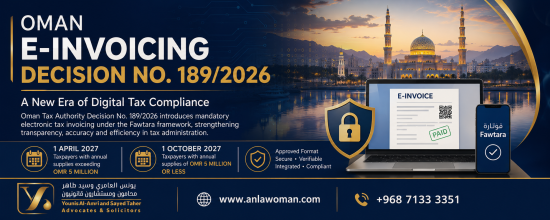
Oman has taken another significant step towards digital tax administration with the introduction of Tax Authority Decision No. 189/2026, establishing the framework for mandatory electronic tax invoicing in the Sultanate.
The reform forms part of Oman's Fawtara electronic invoicing initiative and will progressively move VAT-registered businesses from conventional invoicing to a secure, structured electronic invoicing environment.
For businesses, the change is not simply about replacing paper invoices with electronic documents. It will affect VAT compliance, accounting systems, ERP platforms, invoice controls, data management, record retention and internal processes.
With mandatory implementation scheduled in 2027, businesses should begin preparing now.
1. What Is Oman Tax Authority Decision No. 189/2026?
Tax Authority Decision No. 189/2026 introduces amendments to the VAT regulatory framework relating to the issuance of tax invoices in electronic form.
The Decision provides the legal foundation for the transition towards mandatory electronic tax invoicing, complementing the Oman Tax Authority's Fawtara project.
The objective is to establish a more standardised and secure process for the generation, exchange, verification and storage of tax invoices.
The wider Fawtara initiative is intended to strengthen tax compliance, improve transaction transparency and facilitate more efficient tax administration.
2. What Is E-Invoicing in Oman?
Electronic invoicing, commonly referred to as e-invoicing, involves the creation, exchange and storage of tax invoices in a prescribed electronic format.
An important distinction should be made between an electronic invoice and an ordinary electronic document.
A PDF invoice sent by email, for example, is still essentially a digital representation of a conventional invoice. It does not necessarily satisfy the requirements of a structured electronic invoicing system.
Under Oman's Fawtara framework, electronic invoices are intended to be generated and exchanged in a standardised format capable of automated processing and verification.
3. Key Requirements for Electronic Tax Invoices
The new framework places greater emphasis on the security and integrity of tax-invoice information.
Businesses will need to ensure that their electronic tax invoices satisfy the applicable requirements concerning:
- Approved electronic format – invoices must be generated using the electronic format and technical specifications prescribed by the Tax Authority.
- Security – the invoicing process must protect invoice information against unauthorised alteration or manipulation.
- Integrity – the information contained in the invoice must remain reliable and complete.
- Unique identification – each invoice must be capable of being uniquely identified within the electronic invoicing framework.
- Electronic storage – invoices must be retained electronically in accordance with the applicable requirements.
- Verifiability – the system should allow invoices to be authenticated and verified through the prescribed electronic mechanism.
These requirements mean that businesses should assess the entire invoicing process rather than simply redesigning their invoice template.
4. Is a PDF Invoice an E-Invoice?
Not necessarily.
One of the most important practical points for businesses is that a conventional PDF invoice should not be assumed to constitute a compliant electronic tax invoice.
The Fawtara model is based on structured electronic data that can be processed and exchanged through the approved electronic infrastructure.
Accordingly, once mandatory e-invoicing applies to a taxpayer, simply generating a PDF from accounting software and emailing it to a customer may not satisfy the applicable requirements.
Businesses should therefore review whether their current accounting and ERP systems are capable of supporting the required e-invoicing functionality.
5. Who Will Be Required to Comply?
The electronic invoicing framework is being introduced progressively for businesses falling within the relevant VAT regime.
The OMR 5 million annual-supply threshold is particularly important because it determines the applicable mandatory implementation date.
Businesses should therefore establish their annual supply value and determine which implementation category applies to them.
The reform should not be viewed as affecting only large corporations. Businesses below the OMR 5 million threshold will also need to prepare for the subsequent implementation stage.
6. Mandatory E-Invoicing Deadlines
The mandatory implementation is divided into two principal stages:
| Taxpayer category | Mandatory implementation |
|---|---|
| Annual supplies exceeding OMR 5 million | 1 April 2027 |
| Annual supplies OMR 5 million or less | 1 October 2027 |
The first group therefore has the earlier compliance deadline.
Businesses should begin their implementation programme well before these dates because ERP integration, service-provider selection, testing, data cleansing and employee training may require considerable preparation.
7. What Is Fawtara?
Fawtara is the Oman Tax Authority's electronic invoicing initiative designed to establish a digital ecosystem for tax invoices.
The system is intended to facilitate the electronic creation, exchange, validation and reporting of invoice information.
The Fawtara framework connects the relevant parties in the invoicing chain and enables the Tax Authority to receive relevant tax information electronically.
The initiative forms part of Oman's wider digital transformation of tax administration.
8. Role of E-Invoicing Service Providers
Accredited e-invoicing service providers will play an important role in the Fawtara ecosystem.
Businesses may need to connect their accounting or ERP systems with an approved service provider capable of processing and exchanging electronic invoices in accordance with the Tax Authority's requirements.
When selecting a service provider, businesses should consider:
- technical compatibility;
- integration capabilities;
- information security;
- data protection;
- system availability;
- implementation support;
- scalability; and
- contractual liability for system failures.
The choice of service provider should therefore be treated as a legal, technological and commercial decision, rather than simply a software procurement exercise.
9. The Five-Corner Model
Oman's Fawtara framework is designed around a five-corner model involving:
- Supplier – the business issuing the invoice.
- Supplier's service provider – the accredited provider processing the invoice.
- Buyer – the customer receiving the invoice.
- Buyer's service provider – the provider processing the invoice for the recipient.
- Oman Tax Authority – the regulatory authority receiving relevant tax information.
This model is intended to facilitate secure electronic exchange and improve the accuracy and efficiency of invoice reporting.
10. Impact on VAT Compliance
E-invoicing does not replace the underlying VAT obligations of a taxpayer.
Businesses will continue to be responsible for correctly determining matters such as:
- whether a supply is taxable;
- the applicable VAT rate;
- the taxable value;
- the time of supply;
- VAT identification details;
- credit and debit notes; and
- VAT return reporting.
The difference is that these tax obligations will increasingly be supported by an automated electronic invoicing environment.
Errors that may previously have remained within a paper-based process could therefore become more visible through electronic validation and reporting.
11. Impact on Accounting and ERP Systems
The introduction of mandatory e-invoicing will require many businesses to reassess their existing accounting infrastructure.
Businesses should determine whether their current systems can:
- generate compliant electronic invoices;
- capture all mandatory invoice information;
- communicate with the relevant service provider;
- receive electronic invoices;
- process credit and debit notes;
- maintain appropriate audit trails;
- securely store invoice data; and
- retrieve records when required.
Where existing systems are not compatible, businesses may need to upgrade their ERP or accounting platform or introduce an appropriate integration solution.
12. Data Accuracy Will Become More Important
Electronic invoicing increases the importance of accurate master data.
Businesses should review information relating to:
- customer names;
- commercial registration details;
- VAT registration numbers;
- supplier information;
- product and service classifications;
- tax treatment; and
- invoice values.
In an automated environment, inaccurate or incomplete information can result in validation failures, incorrect VAT reporting or delays in processing.
Data cleansing should therefore form part of every business's e-invoicing implementation plan.
13. Electronic Storage and Record Retention
The new framework also reinforces the importance of electronic invoice storage.
Businesses should ensure that their systems provide appropriate:
- electronic archiving;
- access controls;
- backup procedures;
- data security;
- audit trails; and
- retrieval mechanisms.
The ability to produce an invoice and its underlying electronic record during a tax inspection or audit will become increasingly important.
Businesses should also consider how electronic invoice records interact with their broader document-retention and information-security policies.
14. Implications for B2B Transactions
The impact is likely to be particularly significant for business-to-business transactions.
Electronic exchange can reduce manual invoice processing and improve the matching of invoices with purchase orders, goods receipts and payments.
Potential benefits include:
- faster invoice processing;
- improved VAT reconciliation;
- reduced manual errors;
- better accounts-receivable management;
- better accounts-payable controls; and
- improved auditability.
However, these benefits depend on the accuracy and reliability of the underlying systems and data.
15. What About B2C Transactions?
The operational treatment of business-to-consumer transactions may differ from B2B transactions depending on the applicable technical requirements and further Tax Authority guidance.
Businesses operating significant B2C activities should therefore monitor the Tax Authority's technical specifications and implementation guidance closely.
They should not assume that a process designed for B2B invoicing will automatically satisfy the requirements applicable to consumer transactions.
16. What Businesses Should Do Now
Businesses should begin preparing for e-invoicing well before their applicable deadline.
1. Determine the Applicable Deadline
Calculate the business's annual supply value and determine whether it falls above or below the OMR 5 million threshold.
2. Conduct a Compliance Gap Analysis
Compare existing invoicing processes with the new electronic invoicing requirements.
3. Assess ERP and Accounting Systems
Determine whether existing software can support the required electronic invoice format and integration.
4. Select an Appropriate Service Provider
Evaluate accredited providers based on technology, security, integration, support and contractual terms.
5. Cleanse Business Data
Review customer, supplier, VAT and transaction data for accuracy.
6. Test the System
Testing should cover the complete invoice lifecycle, including issuance, validation, transmission, receipt, correction, cancellation and storage.
7. Review Internal Controls
Establish clear responsibility for invoice creation, approval, correction and cancellation.
8. Train Relevant Personnel
Finance, accounting, tax, IT, sales and procurement teams should understand how the new system affects their functions.
17. Legal and Commercial Implications
The significance of electronic invoicing extends beyond tax administration.
Electronic invoices may become important evidence in:
- payment disputes;
- commercial litigation;
- tax audits;
- contractual claims;
- accounting investigations; and
- regulatory proceedings.
Businesses should therefore ensure that their electronic records are maintained in a manner that supports both tax compliance and evidentiary reliability.
Contracts with ERP providers, service providers and outsourced accounting companies should also be reviewed to determine whether responsibility for data security, system availability, errors and regulatory compliance is appropriately allocated.
18. Key Dates at a Glance
| Date | Significance |
| 9 August 2026 | Decision No. 189/2026 issued |
| August 2026 | Initial Fawtara pilot/readiness activity |
| 1 April 2027 | Mandatory e-invoicing for taxpayers exceeding OMR 5 million annual supplies |
| 1 October 2027 | Mandatory e-invoicing for taxpayers at or below OMR 5 million annual supplies |
Businesses should monitor subsequent Tax Authority guidance for technical specifications, onboarding procedures and any further implementation instructions.
19. YLAW Perspective
Decision No. 189/2026 represents a significant development in Oman's tax-compliance landscape.
The transition to mandatory electronic invoicing will require businesses to coordinate tax, finance, accounting, IT, legal and compliance functions.
The most effective approach is to treat e-invoicing as a structured implementation project rather than a last-minute software upgrade.
Businesses should begin with:
Legal assessment → Tax gap analysis → System assessment → Service-provider selection → Data cleansing → Integration → Testing → Staff training → Go-live
Early preparation will help businesses minimise operational disruption and reduce the risk of non-compliance when the applicable mandatory deadline arrives.
Conclusion
Oman's transition to mandatory electronic tax invoicing marks an important stage in the digitalisation of the country's tax administration.
Tax Authority Decision No. 189/2026 provides the legal framework for the transition, while the Fawtara system provides the technological infrastructure through which electronic invoices will be processed.
For businesses, the immediate priority should be to understand their applicable deadline, assess their existing systems and begin preparing for integration.
With mandatory implementation beginning on 1 April 2027 for taxpayers exceeding the OMR 5 million annual-supply threshold and 1 October 2027 for taxpayers at or below that threshold, businesses should begin their readiness programmes without delay.
E-invoicing is not merely a change in invoice format. It is a fundamental change in the way businesses create, exchange, store and manage tax information in Oman.
Disclaimer: This article is intended for general information purposes only and does not constitute legal or tax advice. Businesses should review Decision No. 189/2026, the VAT Law and Executive Regulations, and the latest technical guidance issued by the Oman Tax Authority in determining their specific compliance obligations.