
Oman’s New Tourism Regulations 2026: Key Licensing, Compliance & Operational Changes
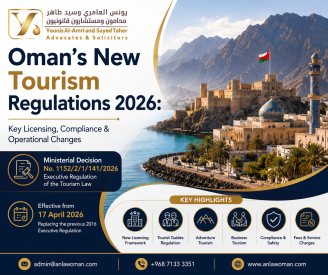
Ministerial Decision No. 1152/2/1/141/2026 – Executive Regulation of the Tourism Law
Oman has introduced a comprehensive new regulatory framework for the tourism sector through Ministerial Decision No. 1152/2/1/141/2026, issued by the Ministry of Heritage and Tourism.
The new Executive Regulation of the Tourism Law came into force on 17 April 2026 and replaces the previous Executive Regulation issued under Ministerial Decision No. 39/2016.
The reform is significant for hotels, travel agencies, tour operators, tourism investors, adventure tourism businesses, tourist guides, and companies operating in the business events sector.
1. A Comprehensive New Tourism Regulatory Framework
The new regulation restructures the licensing and compliance framework for tourism activities in Oman.
Among the principal regulated categories are:
- Tourist and hotel establishments;
- Travel and tourism offices;
- Tourist guides;
- Adventure tourism activities;
- High-art performance groups operating in hotels and restaurants; and
- Business tourism activities, including conferences, exhibitions and corporate incentive programmes.
The express recognition of adventure tourism and business tourism as regulated activities is particularly relevant as Oman continues to develop its tourism and events sectors.
2. Significant Change to Tourism Licensing
One of the most commercially important changes concerns the treatment of tourism licence applications.
Under the new framework, the Ministry generally has 60 days to determine an application. If the Ministry does not issue a decision within the prescribed period, the application may be deemed accepted, subject to satisfaction of the applicable regulatory requirements.
This represents an important change from the previous position and may provide greater certainty to tourism investors and operators.
For investors, licensing certainty can directly affect:
- project commencement;
- financing arrangements;
- lease commitments;
- construction schedules; and
- commercial opening dates.
3. Existing Tourism Establishments Should Review Compliance
The replacement of the previous regulatory framework means that existing tourism establishments should assess whether their current operations remain compliant with the new requirements.
Businesses should consider undertaking a regulatory review covering:
- existing tourism licences;
- permitted activities;
- establishment classification;
- premises and facilities;
- staffing arrangements;
- insurance;
- health, safety and security requirements;
- applicable tourism fees;
- service-charge arrangements; and
- advertising and operational practices.
The Ministry has also called on existing licensed hotel and tourism establishments to regularise their status under the new framework.
4. Adventure Tourism Is Now Specifically Regulated
The regulation introduces a dedicated licensing framework for adventure tourism.
This is particularly relevant to businesses involved in activities such as:
- off-road and desert tourism;
- mountain activities;
- trekking;
- canyoning;
- caving;
- ziplining; and
- other adventure activities.
Adventure-tourism operators face specific safety and risk-management obligations. These include appropriate licensing, security and safety requirements, insurance issued in Oman, specialist licensed guides, risk-management measures and safety plans.
Operators are also expected to consider weather conditions and suspend activities where conditions create safety concerns.
Practical implication
Adventure-tourism businesses should treat safety compliance as an ongoing operational obligation rather than merely a licensing requirement.
5. New Regulatory Framework for Tourist Guides
The regulation provides a more structured framework for tourist guides, including different categories such as:
- general tourist guides;
- location-specific guides; and
- specialised guides.
The framework also regulates matters such as group sizes, permitted activities and professional conduct.
Of particular importance to tourism operators employing expatriates, English-language tourist guiding remains subject to Omani nationality requirements.
Businesses should therefore review their guide recruitment and contracting arrangements.
6. Business Tourism Receives Formal Recognition
Another important development is the recognition of business tourism as a regulated tourism activity.
This encompasses activities connected with:
- conferences;
- exhibitions;
- corporate events; and
- incentive programmes.
The development is particularly relevant to Oman's growing MICE — Meetings, Incentives, Conferences and Exhibitions — sector.
Companies operating in this space should assess whether their activities require licensing or additional approvals under the new framework.
7. Tourism Fees and Service Charges
The regulation also addresses the financial obligations associated with tourism establishments.
According to published commentary on the new regulation, establishments continue to collect a 4% tourism fee for the Ministry and an 8% service charge. The new framework also provides for the service charge to be distributed to employees in cash.
Hotels and tourism establishments should therefore review:
- payroll procedures;
- accounting systems;
- customer invoices;
- employee policies; and
- service-charge distribution mechanisms.
This creates an important intersection between tourism regulation, employment compliance and financial controls.
8. Revised Licence Fees
The new regulation also revises various tourism-related fees.
For example, the reported licence fee for a five-star hotel is OMR 1,900 for three years, compared with the previous fee of OMR 3,200 for five years.
Investors and operators should therefore verify the applicable fee before submitting new applications or renewal requests.
9. Administrative Penalties
The regulation establishes an administrative penalty framework for violations, with administrative fines reported to be capped at OMR 6,000.
The financial exposure reinforces the importance of implementing internal compliance procedures and maintaining appropriate documentation.
10. What Should Tourism Businesses Do Now?
Tourism and hospitality businesses should consider taking the following steps:
Conduct a regulatory gap analysis
Compare existing licences, activities and operational practices against the new regulation.
Review licensing requirements
Confirm whether existing activities fall within a newly regulated category or require additional approvals.
Review employment arrangements
Particularly assess arrangements involving tourist guides, service charges and operational personnel.
Review safety and insurance
Adventure-tourism operators should give particular attention to risk assessments, insurance and emergency procedures.
Review contracts
Hotel management agreements, tourism operator agreements, supplier contracts and customer terms should be reviewed where the regulatory changes affect contractual obligations.
Update internal compliance procedures
Businesses should ensure that staff responsible for licensing, HR, finance and operations understand the new requirements.
Conclusion
Ministerial Decision No. 1152/2/1/141/2026 represents a significant restructuring of Oman's tourism regulatory framework.
The regulation goes beyond licensing and introduces more detailed requirements concerning tourism activities, adventure tourism, tourist guides, business tourism, safety, fees and administrative compliance.
For existing operators, the priority should be a regulatory gap assessment and status review. For new investors, the regulatory framework should be considered at the project-planning stage, before committing to significant leases, financing, construction or operational expenditure.
The new framework also presents opportunities for investors by providing greater regulatory clarity for emerging areas such as adventure and business tourism.
YLAW – Legal Perspective
Businesses operating in Oman's tourism and hospitality sector should approach the new regulation as an ongoing compliance framework rather than a one-time licensing requirement.
A structured legal review can help identify licensing gaps, operational risks, contractual issues and potential regulatory exposure before they develop into disputes or enforcement matters.
Younis Al Amri & Sayed Taher Advocates & Solicitors (YLAW) advises businesses and investors on regulatory compliance, corporate structuring, commercial contracts, employment matters, licensing and investment-related legal issues in Oman.
This article is intended for general information only and does not constitute legal advice. Businesses should obtain advice based on their specific activities, licences and regulatory circumstances.