

Oman E-Invoicing: Key Changes Under Tax Authority Decision No. 189/2026
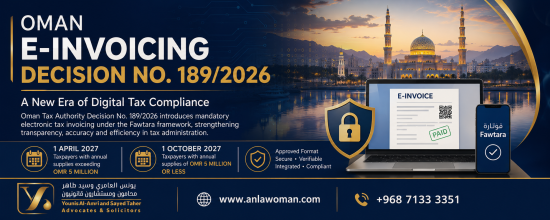
Oman has taken another significant step towards digital tax administration with the introduction of Tax Authority Decision No. 189/2026, establishing the framework for mandatory electronic tax invoicing in the Sultanate.
The reform forms part of Oman's Fawtara electronic invoicing initiative and will progressively move VAT-registered businesses from conventional invoicing to a secure, structured electronic invoicing environment.
For businesses, the change is not simply about replacing paper invoices with electronic documents. It will affect VAT compliance, accounting systems, ERP platforms, invoice controls, data management, record retention and internal processes.
With mandatory implementation scheduled in 2027, businesses should begin preparing now.
1. What Is Oman Tax Authority Decision No. 189/2026?
Tax Authority Decision No. 189/2026 introduces amendments to the VAT regulatory framework relating to the issuance of tax invoices in electronic form.
The Decision provides the legal foundation for the transition towards mandatory electronic tax invoicing, complementing the Oman Tax Authority's Fawtara project.
The objective is to establish a more standardised and secure process for the generation, exchange, verification and storage of tax invoices.
The wider Fawtara initiative is intended to strengthen tax compliance, improve transaction transparency and facilitate more efficient tax administration.
2. What Is E-Invoicing in Oman?
Electronic invoicing, commonly referred to as e-invoicing, involves the creation, exchange and storage of tax invoices in a prescribed electronic format.
An important distinction should be made between an electronic invoice and an ordinary electronic document.
A PDF invoice sent by email, for example, is still essentially a digital representation of a conventional invoice. It does not necessarily satisfy the requirements of a structured electronic invoicing system.
Under Oman's Fawtara framework, electronic invoices are intended to be generated and exchanged in a standardised format capable of automated processing and verification.
3. Key Requirements for Electronic Tax Invoices
The new framework places greater emphasis on the security and integrity of tax-invoice information.
Businesses will need to ensure that their electronic tax invoices satisfy the applicable requirements concerning:
- Approved electronic format – invoices must be generated using the electronic format and technical specifications prescribed by the Tax Authority.
- Security – the invoicing process must protect invoice information against unauthorised alteration or manipulation.
- Integrity – the information contained in the invoice must remain reliable and complete.
- Unique identification – each invoice must be capable of being uniquely identified within the electronic invoicing framework.
- Electronic storage – invoices must be retained electronically in accordance with the applicable requirements.
- Verifiability – the system should allow invoices to be authenticated and verified through the prescribed electronic mechanism.
These requirements mean that businesses should assess the entire invoicing process rather than simply redesigning their invoice template.
4. Is a PDF Invoice an E-Invoice?
Not necessarily.
One of the most important practical points for businesses is that a conventional PDF invoice should not be assumed to constitute a compliant electronic tax invoice.
The Fawtara model is based on structured electronic data that can be processed and exchanged through the approved electronic infrastructure.
Accordingly, once mandatory e-invoicing applies to a taxpayer, simply generating a PDF from accounting software and emailing it to a customer may not satisfy the applicable requirements.
Businesses should therefore review whether their current accounting and ERP systems are capable of supporting the required e-invoicing functionality.
5. Who Will Be Required to Comply?
The electronic invoicing framework is being introduced progressively for businesses falling within the relevant VAT regime.
The OMR 5 million annual-supply threshold is particularly important because it determines the applicable mandatory implementation date.
Businesses should therefore establish their annual supply value and determine which implementation category applies to them.
The reform should not be viewed as affecting only large corporations. Businesses below the OMR 5 million threshold will also need to prepare for the subsequent implementation stage.
6. Mandatory E-Invoicing Deadlines
The mandatory implementation is divided into two principal stages:
| Taxpayer category | Mandatory implementation |
|---|---|
| Annual supplies exceeding OMR 5 million | 1 April 2027 |
| Annual supplies OMR 5 million or less | 1 October 2027 |
The first group therefore has the earlier compliance deadline.
Businesses should begin their implementation programme well before these dates because ERP integration, service-provider selection, testing, data cleansing and employee training may require considerable preparation.
7. What Is Fawtara?
Fawtara is the Oman Tax Authority's electronic invoicing initiative designed to establish a digital ecosystem for tax invoices.
The system is intended to facilitate the electronic creation, exchange, validation and reporting of invoice information.
The Fawtara framework connects the relevant parties in the invoicing chain and enables the Tax Authority to receive relevant tax information electronically.
The initiative forms part of Oman's wider digital transformation of tax administration.
8. Role of E-Invoicing Service Providers
Accredited e-invoicing service providers will play an important role in the Fawtara ecosystem.
Businesses may need to connect their accounting or ERP systems with an approved service provider capable of processing and exchanging electronic invoices in accordance with the Tax Authority's requirements.
When selecting a service provider, businesses should consider:
- technical compatibility;
- integration capabilities;
- information security;
- data protection;
- system availability;
- implementation support;
- scalability; and
- contractual liability for system failures.
The choice of service provider should therefore be treated as a legal, technological and commercial decision, rather than simply a software procurement exercise.
9. The Five-Corner Model
Oman's Fawtara framework is designed around a five-corner model involving:
- Supplier – the business issuing the invoice.
- Supplier's service provider – the accredited provider processing the invoice.
- Buyer – the customer receiving the invoice.
- Buyer's service provider – the provider processing the invoice for the recipient.
- Oman Tax Authority – the regulatory authority receiving relevant tax information.
This model is intended to facilitate secure electronic exchange and improve the accuracy and efficiency of invoice reporting.
10. Impact on VAT Compliance
E-invoicing does not replace the underlying VAT obligations of a taxpayer.
Businesses will continue to be responsible for correctly determining matters such as:
- whether a supply is taxable;
- the applicable VAT rate;
- the taxable value;
- the time of supply;
- VAT identification details;
- credit and debit notes; and
- VAT return reporting.
The difference is that these tax obligations will increasingly be supported by an automated electronic invoicing environment.
Errors that may previously have remained within a paper-based process could therefore become more visible through electronic validation and reporting.
11. Impact on Accounting and ERP Systems
The introduction of mandatory e-invoicing will require many businesses to reassess their existing accounting infrastructure.
Businesses should determine whether their current systems can:
- generate compliant electronic invoices;
- capture all mandatory invoice information;
- communicate with the relevant service provider;
- receive electronic invoices;
- process credit and debit notes;
- maintain appropriate audit trails;
- securely store invoice data; and
- retrieve records when required.
Where existing systems are not compatible, businesses may need to upgrade their ERP or accounting platform or introduce an appropriate integration solution.
12. Data Accuracy Will Become More Important
Electronic invoicing increases the importance of accurate master data.
Businesses should review information relating to:
- customer names;
- commercial registration details;
- VAT registration numbers;
- supplier information;
- product and service classifications;
- tax treatment; and
- invoice values.
In an automated environment, inaccurate or incomplete information can result in validation failures, incorrect VAT reporting or delays in processing.
Data cleansing should therefore form part of every business's e-invoicing implementation plan.
13. Electronic Storage and Record Retention
The new framework also reinforces the importance of electronic invoice storage.
Businesses should ensure that their systems provide appropriate:
- electronic archiving;
- access controls;
- backup procedures;
- data security;
- audit trails; and
- retrieval mechanisms.
The ability to produce an invoice and its underlying electronic record during a tax inspection or audit will become increasingly important.
Businesses should also consider how electronic invoice records interact with their broader document-retention and information-security policies.
14. Implications for B2B Transactions
The impact is likely to be particularly significant for business-to-business transactions.
Electronic exchange can reduce manual invoice processing and improve the matching of invoices with purchase orders, goods receipts and payments.
Potential benefits include:
- faster invoice processing;
- improved VAT reconciliation;
- reduced manual errors;
- better accounts-receivable management;
- better accounts-payable controls; and
- improved auditability.
However, these benefits depend on the accuracy and reliability of the underlying systems and data.
15. What About B2C Transactions?
The operational treatment of business-to-consumer transactions may differ from B2B transactions depending on the applicable technical requirements and further Tax Authority guidance.
Businesses operating significant B2C activities should therefore monitor the Tax Authority's technical specifications and implementation guidance closely.
They should not assume that a process designed for B2B invoicing will automatically satisfy the requirements applicable to consumer transactions.
16. What Businesses Should Do Now
Businesses should begin preparing for e-invoicing well before their applicable deadline.
1. Determine the Applicable Deadline
Calculate the business's annual supply value and determine whether it falls above or below the OMR 5 million threshold.
2. Conduct a Compliance Gap Analysis
Compare existing invoicing processes with the new electronic invoicing requirements.
3. Assess ERP and Accounting Systems
Determine whether existing software can support the required electronic invoice format and integration.
4. Select an Appropriate Service Provider
Evaluate accredited providers based on technology, security, integration, support and contractual terms.
5. Cleanse Business Data
Review customer, supplier, VAT and transaction data for accuracy.
6. Test the System
Testing should cover the complete invoice lifecycle, including issuance, validation, transmission, receipt, correction, cancellation and storage.
7. Review Internal Controls
Establish clear responsibility for invoice creation, approval, correction and cancellation.
8. Train Relevant Personnel
Finance, accounting, tax, IT, sales and procurement teams should understand how the new system affects their functions.
17. Legal and Commercial Implications
The significance of electronic invoicing extends beyond tax administration.
Electronic invoices may become important evidence in:
- payment disputes;
- commercial litigation;
- tax audits;
- contractual claims;
- accounting investigations; and
- regulatory proceedings.
Businesses should therefore ensure that their electronic records are maintained in a manner that supports both tax compliance and evidentiary reliability.
Contracts with ERP providers, service providers and outsourced accounting companies should also be reviewed to determine whether responsibility for data security, system availability, errors and regulatory compliance is appropriately allocated.
18. Key Dates at a Glance
| Date | Significance |
| 9 August 2026 | Decision No. 189/2026 issued |
| August 2026 | Initial Fawtara pilot/readiness activity |
| 1 April 2027 | Mandatory e-invoicing for taxpayers exceeding OMR 5 million annual supplies |
| 1 October 2027 | Mandatory e-invoicing for taxpayers at or below OMR 5 million annual supplies |
Businesses should monitor subsequent Tax Authority guidance for technical specifications, onboarding procedures and any further implementation instructions.
19. YLAW Perspective
Decision No. 189/2026 represents a significant development in Oman's tax-compliance landscape.
The transition to mandatory electronic invoicing will require businesses to coordinate tax, finance, accounting, IT, legal and compliance functions.
The most effective approach is to treat e-invoicing as a structured implementation project rather than a last-minute software upgrade.
Businesses should begin with:
Legal assessment → Tax gap analysis → System assessment → Service-provider selection → Data cleansing → Integration → Testing → Staff training → Go-live
Early preparation will help businesses minimise operational disruption and reduce the risk of non-compliance when the applicable mandatory deadline arrives.
Conclusion
Oman's transition to mandatory electronic tax invoicing marks an important stage in the digitalisation of the country's tax administration.
Tax Authority Decision No. 189/2026 provides the legal framework for the transition, while the Fawtara system provides the technological infrastructure through which electronic invoices will be processed.
For businesses, the immediate priority should be to understand their applicable deadline, assess their existing systems and begin preparing for integration.
With mandatory implementation beginning on 1 April 2027 for taxpayers exceeding the OMR 5 million annual-supply threshold and 1 October 2027 for taxpayers at or below that threshold, businesses should begin their readiness programmes without delay.
E-invoicing is not merely a change in invoice format. It is a fundamental change in the way businesses create, exchange, store and manage tax information in Oman.
Disclaimer: This article is intended for general information purposes only and does not constitute legal or tax advice. Businesses should review Decision No. 189/2026, the VAT Law and Executive Regulations, and the latest technical guidance issued by the Oman Tax Authority in determining their specific compliance obligations.
Oman Tax Authority Decision No. 180/2026: New Rules on Deductible Business Expenses Explained

The Oman Tax Authority has issued Decision No. 180/2026, introducing an important amendment to the Executive Regulation of the Income Tax Law. The Decision inserts a new Article 18 bis into the Executive Regulation, establishing specific conditions under which certain business expenses may qualify as deductible for income tax purposes. The amendments apply from the tax year commencing 1 January 2027. While the amendment is concise, its practical implications are significant for businesses operating in Oman, particularly those incurring costs as a result of directives or decisions issued by government authorities and public entities.
What Has Changed?
Decision No. 180/2026 introduces Article 18 bis to the Executive Regulation of the Income Tax Law. The new provision governs the deductibility of expenses incurred by taxpayers in complying with decisions issued by state administrative units and other public legal entities.
To qualify as a deductible expense, all of the following conditions must be satisfied.
1. The Expense Must Be Necessary for Carrying on the Business
The expenditure must be directly connected to the taxpayer's business activities and genuinely required for the operation of the business.
This requirement reinforces the principle that only legitimate business expenses—rather than optional or unrelated expenditures—should reduce taxable income.
2. The Deduction Must Be Approved by the Chairman of the Tax Authority
The Decision requires that the deduction be expressly authorised by the Chairman of the Tax Authority.
This introduces an additional regulatory safeguard and indicates that expenses falling within the scope of Article 18 bis are not automatically deductible merely because they were incurred.
Businesses should therefore maintain adequate documentation demonstrating the necessity and circumstances of the expenditure when seeking recognition of the deduction.
3. The Expense Must Not Arise from a Breach of Any Legal or Contractual Obligation
The Decision makes it clear that expenses resulting from a failure to comply with any obligation—regardless of whether the obligation arises under law, regulation, contract, or another legal source—will not qualify for deduction.
This provision reinforces the long-standing tax principle that taxpayers should not receive a tax benefit for costs arising from non-compliance or misconduct.
Repeal of Inconsistent Provisions
Decision No. 180/2026 also provides that any provisions inconsistent with the new amendment are repealed to the extent of the inconsistency, ensuring that Article 18 bis prevails over conflicting regulatory provisions.
Effective Date
The Decision was published in the Official Gazette and takes effect from the tax year beginning on 1 January 2027. Businesses should therefore assess their internal tax policies and accounting procedures in advance of the effective date.
Practical Implications for Businesses
The amendment serves as a reminder that taxpayers should:
- Maintain comprehensive records supporting the commercial necessity of expenses.
- Distinguish between compliance-related expenditures and costs arising from breaches of obligations.
- Evaluate whether expenses requiring recognition under Article 18 bis may necessitate approval from the Tax Authority.
- Review existing tax compliance procedures ahead of the 2027 tax year.
Conclusion
Although Decision No. 180/2026 introduces only a single new provision, it strengthens the regulatory framework governing deductible expenses and provides greater clarity on the treatment of costs incurred in complying with governmental directives.
Businesses should proactively review their tax governance frameworks to ensure that qualifying expenditures are appropriately documented and supported before claiming deductions under the amended Executive Regulation.
DOING BUSINESS IN OMAN

Company registration in Oman - International Companies/Investors; No upfront capital required for the incorporation of LLC in Oman.
1.1. LLC Incorporation;
a. LLC Company formation in Sultanate of Oman require an Omani Shareholder (Sponsor) with minimum 30% shareholding and 70% of the outstanding Shareholding with a foreign investor/shareholder.
b. The minimum share capital to register an LLC is Omr 150000(USD 390,000), as per the recent updates of Ministry of Commerce a foreign Company need not to deposit or provide evidence of Omr 150000 share capital investment. The share capital investment can be paid within a period of 2 years from the date of incorporation, which will reflect in the Audited Financial Statement of the Company.
c. Facts of LLC incorporation; i. Each shareholder is liable only to the extent of his/her share capital. ii. Public subscription for raising of funds can be permitted if converted to Joint Stock Company (SAOC, SAOG) in the later stage. iii. A foreign manager can be assigned for the day to day management of the business. iv. The shareholder has the liberty to share profits and losses in a ratio different to the share capital ratio. v. The setting up of an Omani LLC requires only One General Manager and 2 shareholders of any nationality. vi. LLC can be 100% owned subject to the Foreign Investment Laws (applicable to GCC & US investors). vii. Tax levied at 15% flat from the net profit of the Company. viii. No personal income taxes. ix. Employees can only be recruited after establishing a tenancy agreement and registration with the Muscat Municipality and Ministry of Manpower. x. Omanisation targets; Each business must employ a minimum number of Omanis depending on the sector. xi. Registration period 10 to 25 days.
1.2. Free Zone Company Set-up;
1.2.1. Sohar Free Zone
a. Operating from a strategic location on the Arabian Peninsula, Sohar offers an ideal environment for business. The combination of wide market access, sound global logistics and attractive business incentives ensure that your company will enjoy the ultimate freedom to do business. With the existing road network, deep-sea port and airport companies in Sohar can target India, the Middle East, China and South-East Asia while enjoying direct access to Abu Dhabi, Dubai, Al Ain and Muscat, as well as the biggest consumer market in the region, Saudi Arabia. Sohar lies in the center of the Al Batinah region, in the North of Oman. This is a prime area for investment. With its geographical location, economic resources and high population density, the Batinah region has played an important part in Oman`s history. It has always been the country`s maritime and commercial outlet to the Gulf and the Indian Ocean and its mineral resources have provided the basis for several important heavy industries.
b. Company Registration in Sohar The Company registration procedure in Sohar Free Zone is almost similar to that of incorporating an LLC with an added detail of taking lease of the land in the free zone and the Company shall deal in the manufacturing and industrial segment.
c. Advantages of Company Set-up in Sohar Free Zone i. 100% Foreign Ownership. ii. Must have a minimum of 2 shareholders, both of which may be foreign entities. iii. Corporate Tax Holiday of up to 25 Years. iv. A guaranteed 10-year exemption of corporate tax (normally 15% in Oman). v. One-Stop Shop for all Relevant Clearance offering a single window through which all licenses, permits and approvals can be obtained. vi. 0% Import or Re-export Duties. vii. 0% Personal Income Tax. viii. No customs duties for individuals coming in and working in the Free zone. ix. Low Capital Requirements. x. Relaxed Level of Omanisation the minimum Omanisation level for Sohar Port and Free zone is 15%. xi. Free Trade Agreements with US and Singapore.
1.2.2. Duqm Free Zone
a. The Special Economic Zone Authority at Duqm (SEZAD) is a government agency that was established pursuant to Royal Decree No. 119 of 2011 and entrusted with the powers and responsibilities of developing and administering the Zone to become a regional maritime and transit-trade hub, an important complex for export-oriented industries, and an attractive tourism destination and the business gateway to Asia and Europe.
b. Advantages of setting up of Companies in DUQM i. Easy and facilitated access to land based on long term leases and reduced rates. ii. Removal of any restrictions on foreign ownership and minimum investment capital; waiver/reduction of corporate tax and customs duties. iii. This is in addition to nationally applicable incentives such as the waiver of personal income tax, convertibility of currency, and the full repatriation of investment capital and profits. iv. Tax -exemption for 30 years from the date of starting business and for 30 years renewable. This exemption does not apply on banks, financial institutions; insurance and reinsurance companies, telecommunication services providers and land transport companies – unless they are registered with SEZAD and do their business continuously within the boundaries of the area. v. Up to 100% foreign ownership. vi. Exemption from minimum capital requirement stipulated in the commercial companies’ law and other laws. vii. No currency restrictions. viii. Exemption of Commercial Agency Law provisions. ix. Free repatriation of profits & capital. x. Usufruct agreements up to 50 years renewable for similar periods. xi. Freedom to import all kinds of goods (except the legally banned imports) without prior approval or permit unless classified as explosives or chemical products. To import such products, investors should abide by the laws and regulations in force. xii. The imported goods are not subject to any restrictions related to the retention period in the Zone, unless otherwise specified by SEZAD Board of Directors. Investors are also free to transport these goods within or within any other free zone inside the Sultanate. xiii. The finished or assembled products in the area are treated as locally produced products. xiv. The enterprises have the right to open representation office inside the custom jurisdiction subject that they are registered in accordance with the laws and regulations in-force in the Sultanate. xv. The one-stop station provides all necessary services for the enterprises. Through this window, investors can obtain all the required permits, licenses, approvals and visas as well as registration of enterprises and implementing all rules and regulations related to the area and decisions taken by the SEZAD. xvi. Speedy and efficient processing of expatriate manpower applications. The process shall not take more than five working days from the date of submitting the application. xvii. Visas for expatriates and their families' members will be issued by the Passport and Residence Department that is being set up in the area. xviii. The custom system is modernized to ensure speedy processing of goods and transactions. The Department, which uses transparent and clear valuation methodologies, processes the transactions and releases the goods in a very quick and speedy manner while maintaining control of the efficiency. The samples are also fully checked and reported at the same site.