

Royal Decree No. 66/2026: Strengthening Integrity in Oman Through the Criminalisation of Private Sector Bribery
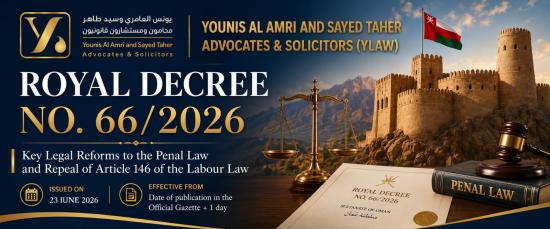
Royal Decree No. 66/2026: Strengthening Integrity in Oman Through the Criminalisation of Private Sector Bribery
The Sultanate of Oman continues to strengthen its legislative framework through Royal Decree No. 66/2026, published on 23 June 2026, introducing significant amendments to the Penal Law (Royal Decree No. 7/2018) while simultaneously repealing Article 146 of the Labour Law (Royal Decree No. 53/2023)
These reforms represent more than a legislative update. They signal Oman's continued commitment to promoting transparency, accountability, ethical business conduct, and alignment with internationally recognized anti-corruption standards.
A Landmark Development in Oman's Criminal Law
Perhaps the most notable aspect of Royal Decree 66/2026 is the introduction of a new chapter dedicated exclusively to bribery in the private sector.
Historically, anti-corruption legislation has focused predominantly on public officials. The new provisions recognize that corruption within private businesses can equally undermine investor confidence, distort competition, damage corporate governance, and negatively impact economic growth.
The amendments therefore extend criminal liability to bribery occurring entirely within private commercial relationships.
The new provisions apply to:
* Private companies operating in Oman;
* Private establishments;
* Public international institutions headquartered in Oman.
However, they do not apply to individuals who fall within the statutory definition of a public official under Article 10(d) of the Penal Law, as those people remain subject to the existing public-sector bribery provisions.
Key Criminal Offences Introduced
1. Acceptance or Solicitation of Benefits
An employer, board member or employee commits an offence where they request, receive or accept any benefit or promise of a benefit in exchange for performing—or refraining from performing—an act connected with their duties.
Penalty
- Imprisonment from 1 to 3 years
- A fine of at least the value of the benefit received or promised
Importantly, liability may arise even where the requested act ultimately falls outside the offender's actual authority.
2. Abuse of Position
Where the benefit is received in exchange for violating employment duties or failing to fulfil a mandatory obligation, the offence becomes significantly more serious.
Penalty
- Imprisonment from 3 to 5 years
- A fine of at least the value of the benefit received or promised
This reflects the legislature's intention to impose stricter sanctions where corruption directly compromises organizational integrity.
3. Offering a Bribe
The legislation also criminalizes offering a bribe—even when the offer is rejected.
Penalty
- Imprisonment from 3 months to 1 year
This demonstrates that criminal liability is not dependent upon the completion of the corrupt transaction.
4. Liability of Bribe Givers and Intermediaries
The Royal Decree places equal emphasis on those who facilitate corruption.
Accordingly:
- The individual offering the bribe; and
- Any intermediary involved;
May be punished with the same penalties applicable to the recipient. However, the law introduces an important compliance incentive. Individuals who voluntarily report the offence before its discovery may benefit from an exemption from criminal punishment. Where disclosure occurs after authorities have discovered the offence, the confession may still be treated as a mitigating factor during sentencing.
Repeal of Article 146 of the Labor Law
Royal Decree No. 66/2026 also repeals Article 146 of the Labor Law in its entirety. Although this amendment may initially appear procedural, it serves an important legislative purpose.
The repeal removes overlapping criminal provisions previously contained within employment legislation, consolidating criminal liability under the Penal Law. This improves legislative consistency while avoiding duplication between labour and criminal statutes.
For employers, HR professionals and legal practitioners, this creates a clearer legal framework governing workplace misconduct involving criminal offences.
Practical Implications for Businesses
The amendments should encourage organizations operating in Oman to reassess their compliance program.
Key considerations include:
- Reviewing anti-bribery and anti-corruption policies.
- Updating employee codes of conduct.
- Strengthening internal reporting mechanisms.
- Conducting risk assessments for procurement and third-party relationships.
- Delivering regular compliance training to employees and management.
- Enhancing board oversight of corporate governance.
Implications for Employees
Employees should recognize that the legislation extends beyond senior management. Liability may arise for any employee who:
- Solicits an improper benefit;
- Accepts gifts linked to official duties;
- Abuse their position for personal gain; or
- Participate in facilitating bribery.
The law therefore reinforces the importance of ethical decision-making throughout every level of the organization.
Implications for Human Resources
HR departments will play a critical role in implementation. Organizations should ensure:
- Employment contracts accurately reflect compliance obligations;
- Disciplinary procedures address bribery-related misconduct;
- Whistleblowing mechanisms remain confidential and effective; and
- Investigations are conducted promptly and fairly.
Final Thoughts
Royal Decree No. 66/2026 represents an important milestone in the evolution of Oman's criminal justice system. Rather than merely increasing penalties, the legislation establishes a comprehensive legal framework addressing corruption within private commercial activity. By clearly defining offences, extending liability to all participants in corrupt transactions, and encouraging voluntary disclosure, the amendments reinforce a culture of integrity across the private sector.
For businesses, the message is clear: compliance is no longer simply a matter of good governance; it is an essential legal obligation.