

Oman's New Executive Regulation of the Securities Law (Decision E/11/2026): A New Era for Capital Markets Regulation

Introduction
The Sultanate of Oman has taken another significant step towards modernising its financial markets with the issuance of Decision No. E/11/2026, promulgating the Executive Regulation of the Securities Law issued under Royal Decree No. 46/2022.
The Regulation provides a detailed framework for implementing the Securities Law. It introduces comprehensive rules governing capital market institutions, securities offerings, investment funds, credit rating agencies, market conduct, investor protection, and regulatory enforcement. It reflects the Financial Services Authority's continued efforts to align Oman's capital markets with international best practices while supporting the objectives of Oman Vision 2040.
More than simply introducing new compliance requirements, the Regulation reshapes the legal and operational framework of Oman's securities market by promoting transparency, strengthening governance, enhancing investor confidence, and creating a more attractive environment for domestic and international investment.
Why This Regulation Matters
While Royal Decree No. 46/2022 established the legal foundation for Oman's modern securities market, its practical implementation depended upon detailed executive regulations. Decision E/11/2026 fills that gap by prescribing the operational rules applicable to market participants.
The Regulation seeks to create a well-regulated, transparent, and competitive capital market by introducing clearer licensing requirements, enhanced disclosure standards, stronger governance obligations, and more effective regulatory oversight. It also supports the introduction of new financial products and services while ensuring that investors benefit from higher levels of protection.
Overview of the Regulation
The Executive Regulation is divided into seven principal chapters, each addressing a key component of Oman's securities market.
1. General Provisions
The Regulation begins by establishing the general legal framework applicable to all participants in the securities market. It sets out key definitions, clarifies the scope of the Regulation, and outlines the fundamental obligations expected of regulated entities.
By providing consistent interpretative guidance, these provisions help reduce regulatory uncertainty and ensure that market participants operate within a clear and predictable legal framework.
2. Capital Market Institutions
One of the Regulation's most significant chapters concerns the licensing and regulation of capital market institutions, including brokerage firms, investment advisers, asset managers, and other regulated financial service providers.
The Regulation prescribes licensing procedures, minimum capital requirements, corporate governance standards, internal control mechanisms, risk management systems, compliance functions, and professional competency requirements for senior management and key personnel.
These measures are intended to strengthen institutional resilience, improve operational standards, and enhance public confidence in licensed financial institutions.
3. Operating Entities
The Regulation establishes detailed requirements for entities responsible for operating and managing the infrastructure of the securities market.
These provisions govern the licensing, responsibilities, operational standards, and ongoing regulatory obligations of market operators, ensuring that trading platforms and market infrastructure function efficiently, fairly, and transparently. The framework also enhances regulatory oversight by requiring operators to maintain appropriate governance, risk management, and reporting systems.
4. Credit Rating Agencies
Recognising the growing importance of independent credit assessments, the Regulation introduces a dedicated legal framework governing credit rating agencies.
The new rules establish licensing requirements together with obligations relating to independence, transparency, governance, record keeping, conflict-of-interest management, and internal controls. These measures are designed to improve the credibility and reliability of credit ratings, thereby enabling investors to make better-informed investment decisions.
5. Collective Investment Schemes
The Regulation significantly enhances the regulatory framework governing investment funds and other collective investment schemes.
It provides detailed rules relating to the establishment, licensing, management, administration, custody, valuation, disclosure, and ongoing supervision of investment funds. Fund managers are also subject to enhanced governance and compliance obligations aimed at safeguarding investors' interests and promoting sound fund management practices.
The revised framework is expected to encourage greater institutional investment while expanding the range of investment products available in Oman.
6. Issuers and Market Integrity
This chapter introduces extensive obligations designed to promote transparency and preserve confidence in the securities market.
Issuers are required to comply with enhanced disclosure requirements, including continuous reporting of material developments that may affect investors' decisions. The Regulation also contains provisions addressing insider trading, market manipulation, misleading disclosures, and other forms of market abuse.
Collectively, these measures reinforce the principles of fairness, equal treatment of investors, and integrity within Oman's capital markets.
7. Grievance Committee
To ensure procedural fairness, the Regulation establishes a formal mechanism for reviewing decisions issued by the Financial Services Authority.
The chapter sets out the procedures for filing grievances, conducting hearings, and issuing decisions. This structured review process strengthens regulatory accountability while providing market participants with an effective avenue to challenge regulatory decisions where appropriate.
Investment Banking Recognised as a Regulated Activity
One of the Regulation's most notable reforms is the formal recognition of investment banking as a regulated securities activity.
Licensed investment banks may undertake a broad range of services, including advising on securities issuances, underwriting public offerings, managing investment portfolios, providing investment research, structuring financial products, and offering corporate finance advisory services.
By expressly regulating investment banking, Oman moves closer to internationally recognised capital market frameworks and creates opportunities for more sophisticated financial services within the Sultanate.
Structural Separation of Banks' Securities Activities
The Regulation also introduces an important structural reform for licensed banks currently carrying out securities-related business.
Banks have been granted a three-year transitional period to transfer regulated securities activities into a separate legal entity. This segregation is intended to minimise conflicts of interest, improve governance, and enable more focused regulatory supervision.
Certain activities—including custody services, trustee functions, and underwriting—may continue to be undertaken by banks where permitted under the Regulation.
Transitional Compliance Requirements
To facilitate implementation, the Regulation grants existing capital market institutions a six-month period to regularise their operations and ensure compliance with the new requirements.
Until supplementary rules and guidance are issued by the Financial Services Authority, existing circulars and regulatory instructions will continue to apply insofar as they do not conflict with the Securities Law or the Executive Regulation. This transitional approach allows firms sufficient time to review their governance structures, internal policies, licensing arrangements, and compliance frameworks.
What Does This Mean for Businesses?
The new Executive Regulation will require many market participants to reassess their internal governance and regulatory compliance frameworks.
Listed companies should review their disclosure policies and reporting procedures to ensure continued compliance. Licensed financial institutions may need to strengthen governance arrangements, risk management systems, and internal controls. Banks engaged in securities activities should begin planning for the required structural separation, while investment managers and fund operators should evaluate whether their existing operational models satisfy the enhanced regulatory standards.
For investors, these reforms should result in greater market transparency, stronger regulatory oversight, and improved confidence in Oman's capital markets.
Conclusion
Decision No. E/11/2026 represents one of the most significant milestones in the evolution of Oman's capital markets since the enactment of the Securities Law in 2022. By introducing a modern and comprehensive regulatory framework, the Financial Services Authority has strengthened the legal foundations of the securities sector while fostering greater investor confidence, market integrity, and institutional accountability.
Although the Regulation introduces new compliance obligations for regulated entities, it also presents significant opportunities. By encouraging innovation, improving governance, and aligning Oman with international regulatory standards, the new framework is expected to enhance the attractiveness of the Sultanate as a regional investment destination and support the broader economic diversification goals of Oman Vision 2040.
Oman's New Executive Regulation of the Securities Law (Decision E/11/2026): A New Era for Capital Markets Regulation
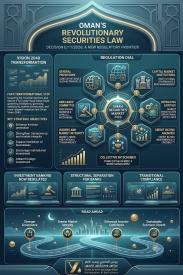
Introduction
The Sultanate of Oman has taken another significant step towards modernising its financial markets with the issuance of Decision No. E/11/2026, promulgating the Executive Regulation of the Securities Law issued under Royal Decree No. 46/2022.
The Regulation provides a detailed framework for implementing the Securities Law. It introduces comprehensive rules governing capital market institutions, securities offerings, investment funds, credit rating agencies, market conduct, investor protection, and regulatory enforcement. It reflects the Financial Services Authority's continued efforts to align Oman's capital markets with international best practices while supporting the objectives of Oman Vision 2040.
More than simply introducing new compliance requirements, the Regulation reshapes the legal and operational framework of Oman's securities market by promoting transparency, strengthening governance, enhancing investor confidence, and creating a more attractive environment for domestic and international investment.
Why This Regulation Matters
While Royal Decree No. 46/2022 established the legal foundation for Oman's modern securities market, its practical implementation depended upon detailed executive regulations. Decision E/11/2026 fills that gap by prescribing the operational rules applicable to market participants.
The Regulation seeks to create a well-regulated, transparent, and competitive capital market by introducing clearer licensing requirements, enhanced disclosure standards, stronger governance obligations, and more effective regulatory oversight. It also supports the introduction of new financial products and services while ensuring that investors benefit from higher levels of protection.
Overview of the Regulation
The Executive Regulation is divided into seven principal chapters, each addressing a key component of Oman's securities market.
1. General Provisions
The Regulation begins by establishing the general legal framework applicable to all participants in the securities market. It sets out key definitions, clarifies the scope of the Regulation, and outlines the fundamental obligations expected of regulated entities.
By providing consistent interpretative guidance, these provisions help reduce regulatory uncertainty and ensure that market participants operate within a clear and predictable legal framework.
2. Capital Market Institutions
One of the Regulation's most significant chapters concerns the licensing and regulation of capital market institutions, including brokerage firms, investment advisers, asset managers, and other regulated financial service providers.
The Regulation prescribes licensing procedures, minimum capital requirements, corporate governance standards, internal control mechanisms, risk management systems, compliance functions, and professional competency requirements for senior management and key personnel.
These measures are intended to strengthen institutional resilience, improve operational standards, and enhance public confidence in licensed financial institutions.
3. Operating Entities
The Regulation establishes detailed requirements for entities responsible for operating and managing the infrastructure of the securities market.
These provisions govern the licensing, responsibilities, operational standards, and ongoing regulatory obligations of market operators, ensuring that trading platforms and market infrastructure function efficiently, fairly, and transparently. The framework also enhances regulatory oversight by requiring operators to maintain appropriate governance, risk management, and reporting systems.
4. Credit Rating Agencies
Recognising the growing importance of independent credit assessments, the Regulation introduces a dedicated legal framework governing credit rating agencies.
The new rules establish licensing requirements together with obligations relating to independence, transparency, governance, record keeping, conflict-of-interest management, and internal controls. These measures are designed to improve the credibility and reliability of credit ratings, thereby enabling investors to make better-informed investment decisions.
5. Collective Investment Schemes
The Regulation significantly enhances the regulatory framework governing investment funds and other collective investment schemes.
It provides detailed rules relating to the establishment, licensing, management, administration, custody, valuation, disclosure, and ongoing supervision of investment funds. Fund managers are also subject to enhanced governance and compliance obligations aimed at safeguarding investors' interests and promoting sound fund management practices.
The revised framework is expected to encourage greater institutional investment while expanding the range of investment products available in Oman.
6. Issuers and Market Integrity
This chapter introduces extensive obligations designed to promote transparency and preserve confidence in the securities market.
Issuers are required to comply with enhanced disclosure requirements, including continuous reporting of material developments that may affect investors' decisions. The Regulation also contains provisions addressing insider trading, market manipulation, misleading disclosures, and other forms of market abuse.
Collectively, these measures reinforce the principles of fairness, equal treatment of investors, and integrity within Oman's capital markets.
7. Grievance Committee
To ensure procedural fairness, the Regulation establishes a formal mechanism for reviewing decisions issued by the Financial Services Authority.
The chapter sets out the procedures for filing grievances, conducting hearings, and issuing decisions. This structured review process strengthens regulatory accountability while providing market participants with an effective avenue to challenge regulatory decisions where appropriate.
Investment Banking Recognised as a Regulated Activity
One of the Regulation's most notable reforms is the formal recognition of investment banking as a regulated securities activity.
Licensed investment banks may undertake a broad range of services, including advising on securities issuances, underwriting public offerings, managing investment portfolios, providing investment research, structuring financial products, and offering corporate finance advisory services.
By expressly regulating investment banking, Oman moves closer to internationally recognised capital market frameworks and creates opportunities for more sophisticated financial services within the Sultanate.
Structural Separation of Banks' Securities Activities
The Regulation also introduces an important structural reform for licensed banks currently carrying out securities-related business.
Banks have been granted a three-year transitional period to transfer regulated securities activities into a separate legal entity. This segregation is intended to minimise conflicts of interest, improve governance, and enable more focused regulatory supervision.
Certain activities—including custody services, trustee functions, and underwriting—may continue to be undertaken by banks where permitted under the Regulation.
Transitional Compliance Requirements
To facilitate implementation, the Regulation grants existing capital market institutions a six-month period to regularise their operations and ensure compliance with the new requirements.
Until supplementary rules and guidance are issued by the Financial Services Authority, existing circulars and regulatory instructions will continue to apply insofar as they do not conflict with the Securities Law or the Executive Regulation. This transitional approach allows firms sufficient time to review their governance structures, internal policies, licensing arrangements, and compliance frameworks.
What Does This Mean for Businesses?
The new Executive Regulation will require many market participants to reassess their internal governance and regulatory compliance frameworks.
Listed companies should review their disclosure policies and reporting procedures to ensure continued compliance. Licensed financial institutions may need to strengthen governance arrangements, risk management systems, and internal controls. Banks engaged in securities activities should begin planning for the required structural separation, while investment managers and fund operators should evaluate whether their existing operational models satisfy the enhanced regulatory standards.
For investors, these reforms should result in greater market transparency, stronger regulatory oversight, and improved confidence in Oman's capital markets.
Conclusion
Decision No. E/11/2026 represents one of the most significant milestones in the evolution of Oman's capital markets since the enactment of the Securities Law in 2022. By introducing a modern and comprehensive regulatory framework, the Financial Services Authority has strengthened the legal foundations of the securities sector while fostering greater investor confidence, market integrity, and institutional accountability.
Although the Regulation introduces new compliance obligations for regulated entities, it also presents significant opportunities. By encouraging innovation, improving governance, and aligning Oman with international regulatory standards, the new framework is expected to enhance the attractiveness of the Sultanate as a regional investment destination and support the broader economic diversification goals of Oman Vision 2040.
Oman's New Executive Regulation of the Securities Law (Decision E/11/2026): A New Era for Capital Markets Regulation
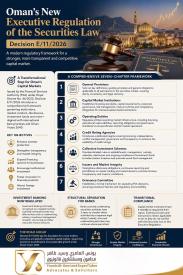
Introduction
The Sultanate of Oman has taken another significant step towards modernising its financial markets with the issuance of Decision No. E/11/2026, promulgating the Executive Regulation of the Securities Law issued under Royal Decree No. 46/2022.
The Regulation provides a detailed framework for implementing the Securities Law. It introduces comprehensive rules governing capital market institutions, securities offerings, investment funds, credit rating agencies, market conduct, investor protection, and regulatory enforcement. It reflects the Financial Services Authority's continued efforts to align Oman's capital markets with international best practices while supporting the objectives of Oman Vision 2040.
More than simply introducing new compliance requirements, the Regulation reshapes the legal and operational framework of Oman's securities market by promoting transparency, strengthening governance, enhancing investor confidence, and creating a more attractive environment for domestic and international investment.
Why This Regulation Matters
While Royal Decree No. 46/2022 established the legal foundation for Oman's modern securities market, its practical implementation depended upon detailed executive regulations. Decision E/11/2026 fills that gap by prescribing the operational rules applicable to market participants.
The Regulation seeks to create a well-regulated, transparent, and competitive capital market by introducing clearer licensing requirements, enhanced disclosure standards, stronger governance obligations, and more effective regulatory oversight. It also supports the introduction of new financial products and services while ensuring that investors benefit from higher levels of protection.
Overview of the Regulation
The Executive Regulation is divided into seven principal chapters, each addressing a key component of Oman's securities market.
1. General Provisions
The Regulation begins by establishing the general legal framework applicable to all participants in the securities market. It sets out key definitions, clarifies the scope of the Regulation, and outlines the fundamental obligations expected of regulated entities.
By providing consistent interpretative guidance, these provisions help reduce regulatory uncertainty and ensure that market participants operate within a clear and predictable legal framework.
2. Capital Market Institutions
One of the Regulation's most significant chapters concerns the licensing and regulation of capital market institutions, including brokerage firms, investment advisers, asset managers, and other regulated financial service providers.
The Regulation prescribes licensing procedures, minimum capital requirements, corporate governance standards, internal control mechanisms, risk management systems, compliance functions, and professional competency requirements for senior management and key personnel.
These measures are intended to strengthen institutional resilience, improve operational standards, and enhance public confidence in licensed financial institutions.
3. Operating Entities
The Regulation establishes detailed requirements for entities responsible for operating and managing the infrastructure of the securities market.
These provisions govern the licensing, responsibilities, operational standards, and ongoing regulatory obligations of market operators, ensuring that trading platforms and market infrastructure function efficiently, fairly, and transparently. The framework also enhances regulatory oversight by requiring operators to maintain appropriate governance, risk management, and reporting systems.
4. Credit Rating Agencies
Recognising the growing importance of independent credit assessments, the Regulation introduces a dedicated legal framework governing credit rating agencies.
The new rules establish licensing requirements together with obligations relating to independence, transparency, governance, record keeping, conflict-of-interest management, and internal controls. These measures are designed to improve the credibility and reliability of credit ratings, thereby enabling investors to make better-informed investment decisions.
5. Collective Investment Schemes
The Regulation significantly enhances the regulatory framework governing investment funds and other collective investment schemes.
It provides detailed rules relating to the establishment, licensing, management, administration, custody, valuation, disclosure, and ongoing supervision of investment funds. Fund managers are also subject to enhanced governance and compliance obligations aimed at safeguarding investors' interests and promoting sound fund management practices.
The revised framework is expected to encourage greater institutional investment while expanding the range of investment products available in Oman.
6. Issuers and Market Integrity
This chapter introduces extensive obligations designed to promote transparency and preserve confidence in the securities market.
Issuers are required to comply with enhanced disclosure requirements, including continuous reporting of material developments that may affect investors' decisions. The Regulation also contains provisions addressing insider trading, market manipulation, misleading disclosures, and other forms of market abuse.
Collectively, these measures reinforce the principles of fairness, equal treatment of investors, and integrity within Oman's capital markets.
7. Grievance Committee
To ensure procedural fairness, the Regulation establishes a formal mechanism for reviewing decisions issued by the Financial Services Authority.
The chapter sets out the procedures for filing grievances, conducting hearings, and issuing decisions. This structured review process strengthens regulatory accountability while providing market participants with an effective avenue to challenge regulatory decisions where appropriate.
Investment Banking Recognised as a Regulated Activity
One of the Regulation's most notable reforms is the formal recognition of investment banking as a regulated securities activity.
Licensed investment banks may undertake a broad range of services, including advising on securities issuances, underwriting public offerings, managing investment portfolios, providing investment research, structuring financial products, and offering corporate finance advisory services.
By expressly regulating investment banking, Oman moves closer to internationally recognised capital market frameworks and creates opportunities for more sophisticated financial services within the Sultanate.
Structural Separation of Banks' Securities Activities
The Regulation also introduces an important structural reform for licensed banks currently carrying out securities-related business.
Banks have been granted a three-year transitional period to transfer regulated securities activities into a separate legal entity. This segregation is intended to minimise conflicts of interest, improve governance, and enable more focused regulatory supervision.
Certain activities—including custody services, trustee functions, and underwriting—may continue to be undertaken by banks where permitted under the Regulation.
Transitional Compliance Requirements
To facilitate implementation, the Regulation grants existing capital market institutions a six-month period to regularise their operations and ensure compliance with the new requirements.
Until supplementary rules and guidance are issued by the Financial Services Authority, existing circulars and regulatory instructions will continue to apply insofar as they do not conflict with the Securities Law or the Executive Regulation. This transitional approach allows firms sufficient time to review their governance structures, internal policies, licensing arrangements, and compliance frameworks.
What Does This Mean for Businesses?
The new Executive Regulation will require many market participants to reassess their internal governance and regulatory compliance frameworks.
Listed companies should review their disclosure policies and reporting procedures to ensure continued compliance. Licensed financial institutions may need to strengthen governance arrangements, risk management systems, and internal controls. Banks engaged in securities activities should begin planning for the required structural separation, while investment managers and fund operators should evaluate whether their existing operational models satisfy the enhanced regulatory standards.
For investors, these reforms should result in greater market transparency, stronger regulatory oversight, and improved confidence in Oman's capital markets.
Conclusion
Decision No. E/11/2026 represents one of the most significant milestones in the evolution of Oman's capital markets since the enactment of the Securities Law in 2022. By introducing a modern and comprehensive regulatory framework, the Financial Services Authority has strengthened the legal foundations of the securities sector while fostering greater investor confidence, market integrity, and institutional accountability.
Although the Regulation introduces new compliance obligations for regulated entities, it also presents significant opportunities. By encouraging innovation, improving governance, and aligning Oman with international regulatory standards, the new framework is expected to enhance the attractiveness of the Sultanate as a regional investment destination and support the broader economic diversification goals of Oman Vision 2040.
Oman's New Executive Regulation of the Securities Law (Decision E/11/2026): A New Era for Capital Markets Regulation
Introduction
The Sultanate of Oman has taken another significant step towards modernising its financial markets with the issuance of Decision No. E/11/2026, promulgating the Executive Regulation of the Securities Law issued under Royal Decree No. 46/2022.
The Regulation provides a detailed framework for implementing the Securities Law. It introduces comprehensive rules governing capital market institutions, securities offerings, investment funds, credit rating agencies, market conduct, investor protection, and regulatory enforcement. It reflects the Financial Services Authority's continued efforts to align Oman's capital markets with international best practices while supporting the objectives of Oman Vision 2040.
More than simply introducing new compliance requirements, the Regulation reshapes the legal and operational framework of Oman's securities market by promoting transparency, strengthening governance, enhancing investor confidence, and creating a more attractive environment for domestic and international investment.
Why This Regulation Matters
While Royal Decree No. 46/2022 established the legal foundation for Oman's modern securities market, its practical implementation depended upon detailed executive regulations. Decision E/11/2026 fills that gap by prescribing the operational rules applicable to market participants.
The Regulation seeks to create a well-regulated, transparent, and competitive capital market by introducing clearer licensing requirements, enhanced disclosure standards, stronger governance obligations, and more effective regulatory oversight. It also supports the introduction of new financial products and services while ensuring that investors benefit from higher levels of protection.
Overview of the Regulation
The Executive Regulation is divided into seven principal chapters, each addressing a key component of Oman's securities market.
1. General Provisions
The Regulation begins by establishing the general legal framework applicable to all participants in the securities market. It sets out key definitions, clarifies the scope of the Regulation, and outlines the fundamental obligations expected of regulated entities.
By providing consistent interpretative guidance, these provisions help reduce regulatory uncertainty and ensure that market participants operate within a clear and predictable legal framework.
2. Capital Market Institutions
One of the Regulation's most significant chapters concerns the licensing and regulation of capital market institutions, including brokerage firms, investment advisers, asset managers, and other regulated financial service providers.
The Regulation prescribes licensing procedures, minimum capital requirements, corporate governance standards, internal control mechanisms, risk management systems, compliance functions, and professional competency requirements for senior management and key personnel.
These measures are intended to strengthen institutional resilience, improve operational standards, and enhance public confidence in licensed financial institutions.
3. Operating Entities
The Regulation establishes detailed requirements for entities responsible for operating and managing the infrastructure of the securities market.
These provisions govern the licensing, responsibilities, operational standards, and ongoing regulatory obligations of market operators, ensuring that trading platforms and market infrastructure function efficiently, fairly, and transparently. The framework also enhances regulatory oversight by requiring operators to maintain appropriate governance, risk management, and reporting systems.
4. Credit Rating Agencies
Recognising the growing importance of independent credit assessments, the Regulation introduces a dedicated legal framework governing credit rating agencies.
The new rules establish licensing requirements together with obligations relating to independence, transparency, governance, record keeping, conflict-of-interest management, and internal controls. These measures are designed to improve the credibility and reliability of credit ratings, thereby enabling investors to make better-informed investment decisions.
5. Collective Investment Schemes
The Regulation significantly enhances the regulatory framework governing investment funds and other collective investment schemes.
It provides detailed rules relating to the establishment, licensing, management, administration, custody, valuation, disclosure, and ongoing supervision of investment funds. Fund managers are also subject to enhanced governance and compliance obligations aimed at safeguarding investors' interests and promoting sound fund management practices.
The revised framework is expected to encourage greater institutional investment while expanding the range of investment products available in Oman.
6. Issuers and Market Integrity
This chapter introduces extensive obligations designed to promote transparency and preserve confidence in the securities market.
Issuers are required to comply with enhanced disclosure requirements, including continuous reporting of material developments that may affect investors' decisions. The Regulation also contains provisions addressing insider trading, market manipulation, misleading disclosures, and other forms of market abuse.
Collectively, these measures reinforce the principles of fairness, equal treatment of investors, and integrity within Oman's capital markets.
7. Grievance Committee
To ensure procedural fairness, the Regulation establishes a formal mechanism for reviewing decisions issued by the Financial Services Authority.
The chapter sets out the procedures for filing grievances, conducting hearings, and issuing decisions. This structured review process strengthens regulatory accountability while providing market participants with an effective avenue to challenge regulatory decisions where appropriate.
Investment Banking Recognised as a Regulated Activity
One of the Regulation's most notable reforms is the formal recognition of investment banking as a regulated securities activity.
Licensed investment banks may undertake a broad range of services, including advising on securities issuances, underwriting public offerings, managing investment portfolios, providing investment research, structuring financial products, and offering corporate finance advisory services.
By expressly regulating investment banking, Oman moves closer to internationally recognised capital market frameworks and creates opportunities for more sophisticated financial services within the Sultanate.
Structural Separation of Banks' Securities Activities
The Regulation also introduces an important structural reform for licensed banks currently carrying out securities-related business.
Banks have been granted a three-year transitional period to transfer regulated securities activities into a separate legal entity. This segregation is intended to minimise conflicts of interest, improve governance, and enable more focused regulatory supervision.
Certain activities—including custody services, trustee functions, and underwriting—may continue to be undertaken by banks where permitted under the Regulation.
Transitional Compliance Requirements
To facilitate implementation, the Regulation grants existing capital market institutions a six-month period to regularise their operations and ensure compliance with the new requirements.
Until supplementary rules and guidance are issued by the Financial Services Authority, existing circulars and regulatory instructions will continue to apply insofar as they do not conflict with the Securities Law or the Executive Regulation. This transitional approach allows firms sufficient time to review their governance structures, internal policies, licensing arrangements, and compliance frameworks.
What Does This Mean for Businesses?
The new Executive Regulation will require many market participants to reassess their internal governance and regulatory compliance frameworks.
Listed companies should review their disclosure policies and reporting procedures to ensure continued compliance. Licensed financial institutions may need to strengthen governance arrangements, risk management systems, and internal controls. Banks engaged in securities activities should begin planning for the required structural separation, while investment managers and fund operators should evaluate whether their existing operational models satisfy the enhanced regulatory standards.
For investors, these reforms should result in greater market transparency, stronger regulatory oversight, and improved confidence in Oman's capital markets.
Conclusion
Decision No. E/11/2026 represents one of the most significant milestones in the evolution of Oman's capital markets since the enactment of the Securities Law in 2022. By introducing a modern and comprehensive regulatory framework, the Financial Services Authority has strengthened the legal foundations of the securities sector while fostering greater investor confidence, market integrity, and institutional accountability.
Although the Regulation introduces new compliance obligations for regulated entities, it also presents significant opportunities. By encouraging innovation, improving governance, and aligning Oman with international regulatory standards, the new framework is expected to enhance the attractiveness of the Sultanate as a regional investment destination and support the broader economic diversification goals of Oman Vision 2040.
Oman's New Executive Regulation of the Securities Law (Decision E/11/2026): A New Era for Capital Markets Regulation
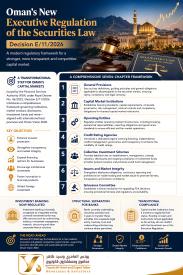
Introduction
The Sultanate of Oman has taken another significant step towards modernising its financial markets with the issuance of Decision No. E/11/2026, promulgating the Executive Regulation of the Securities Law issued under Royal Decree No. 46/2022.
The Regulation provides a detailed framework for implementing the Securities Law. It introduces comprehensive rules governing capital market institutions, securities offerings, investment funds, credit rating agencies, market conduct, investor protection, and regulatory enforcement. It reflects the Financial Services Authority's continued efforts to align Oman's capital markets with international best practices while supporting the objectives of Oman Vision 2040.
More than simply introducing new compliance requirements, the Regulation reshapes the legal and operational framework of Oman's securities market by promoting transparency, strengthening governance, enhancing investor confidence, and creating a more attractive environment for domestic and international investment.
Why This Regulation Matters
While Royal Decree No. 46/2022 established the legal foundation for Oman's modern securities market, its practical implementation depended upon detailed executive regulations. Decision E/11/2026 fills that gap by prescribing the operational rules applicable to market participants.
The Regulation seeks to create a well-regulated, transparent, and competitive capital market by introducing clearer licensing requirements, enhanced disclosure standards, stronger governance obligations, and more effective regulatory oversight. It also supports the introduction of new financial products and services while ensuring that investors benefit from higher levels of protection.
Overview of the Regulation
The Executive Regulation is divided into seven principal chapters, each addressing a key component of Oman's securities market.
1. General Provisions
The Regulation begins by establishing the general legal framework applicable to all participants in the securities market. It sets out key definitions, clarifies the scope of the Regulation, and outlines the fundamental obligations expected of regulated entities.
By providing consistent interpretative guidance, these provisions help reduce regulatory uncertainty and ensure that market participants operate within a clear and predictable legal framework.
2. Capital Market Institutions
One of the Regulation's most significant chapters concerns the licensing and regulation of capital market institutions, including brokerage firms, investment advisers, asset managers, and other regulated financial service providers.
The Regulation prescribes licensing procedures, minimum capital requirements, corporate governance standards, internal control mechanisms, risk management systems, compliance functions, and professional competency requirements for senior management and key personnel.
These measures are intended to strengthen institutional resilience, improve operational standards, and enhance public confidence in licensed financial institutions.
3. Operating Entities
The Regulation establishes detailed requirements for entities responsible for operating and managing the infrastructure of the securities market.
These provisions govern the licensing, responsibilities, operational standards, and ongoing regulatory obligations of market operators, ensuring that trading platforms and market infrastructure function efficiently, fairly, and transparently. The framework also enhances regulatory oversight by requiring operators to maintain appropriate governance, risk management, and reporting systems.
4. Credit Rating Agencies
Recognising the growing importance of independent credit assessments, the Regulation introduces a dedicated legal framework governing credit rating agencies.
The new rules establish licensing requirements together with obligations relating to independence, transparency, governance, record keeping, conflict-of-interest management, and internal controls. These measures are designed to improve the credibility and reliability of credit ratings, thereby enabling investors to make better-informed investment decisions.
5. Collective Investment Schemes
The Regulation significantly enhances the regulatory framework governing investment funds and other collective investment schemes.
It provides detailed rules relating to the establishment, licensing, management, administration, custody, valuation, disclosure, and ongoing supervision of investment funds. Fund managers are also subject to enhanced governance and compliance obligations aimed at safeguarding investors' interests and promoting sound fund management practices.
The revised framework is expected to encourage greater institutional investment while expanding the range of investment products available in Oman.
6. Issuers and Market Integrity
This chapter introduces extensive obligations designed to promote transparency and preserve confidence in the securities market.
Issuers are required to comply with enhanced disclosure requirements, including continuous reporting of material developments that may affect investors' decisions. The Regulation also contains provisions addressing insider trading, market manipulation, misleading disclosures, and other forms of market abuse.
Collectively, these measures reinforce the principles of fairness, equal treatment of investors, and integrity within Oman's capital markets.
7. Grievance Committee
To ensure procedural fairness, the Regulation establishes a formal mechanism for reviewing decisions issued by the Financial Services Authority.
The chapter sets out the procedures for filing grievances, conducting hearings, and issuing decisions. This structured review process strengthens regulatory accountability while providing market participants with an effective avenue to challenge regulatory decisions where appropriate.
Investment Banking Recognised as a Regulated Activity
One of the Regulation's most notable reforms is the formal recognition of investment banking as a regulated securities activity.
Licensed investment banks may undertake a broad range of services, including advising on securities issuances, underwriting public offerings, managing investment portfolios, providing investment research, structuring financial products, and offering corporate finance advisory services.
By expressly regulating investment banking, Oman moves closer to internationally recognised capital market frameworks and creates opportunities for more sophisticated financial services within the Sultanate.
Structural Separation of Banks' Securities Activities
The Regulation also introduces an important structural reform for licensed banks currently carrying out securities-related business.
Banks have been granted a three-year transitional period to transfer regulated securities activities into a separate legal entity. This segregation is intended to minimise conflicts of interest, improve governance, and enable more focused regulatory supervision.
Certain activities—including custody services, trustee functions, and underwriting—may continue to be undertaken by banks where permitted under the Regulation.
Transitional Compliance Requirements
To facilitate implementation, the Regulation grants existing capital market institutions a six-month period to regularise their operations and ensure compliance with the new requirements.
Until supplementary rules and guidance are issued by the Financial Services Authority, existing circulars and regulatory instructions will continue to apply insofar as they do not conflict with the Securities Law or the Executive Regulation. This transitional approach allows firms sufficient time to review their governance structures, internal policies, licensing arrangements, and compliance frameworks.
What Does This Mean for Businesses?
The new Executive Regulation will require many market participants to reassess their internal governance and regulatory compliance frameworks.
Listed companies should review their disclosure policies and reporting procedures to ensure continued compliance. Licensed financial institutions may need to strengthen governance arrangements, risk management systems, and internal controls. Banks engaged in securities activities should begin planning for the required structural separation, while investment managers and fund operators should evaluate whether their existing operational models satisfy the enhanced regulatory standards.
For investors, these reforms should result in greater market transparency, stronger regulatory oversight, and improved confidence in Oman's capital markets.
Conclusion
Decision No. E/11/2026 represents one of the most significant milestones in the evolution of Oman's capital markets since the enactment of the Securities Law in 2022. By introducing a modern and comprehensive regulatory framework, the Financial Services Authority has strengthened the legal foundations of the securities sector while fostering greater investor confidence, market integrity, and institutional accountability.
Although the Regulation introduces new compliance obligations for regulated entities, it also presents significant opportunities. By encouraging innovation, improving governance, and aligning Oman with international regulatory standards, the new framework is expected to enhance the attractiveness of the Sultanate as a regional investment destination and support the broader economic diversification goals of Oman Vision 2040.